
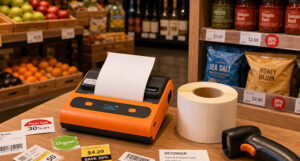
In today’s fast-paced corporate logistics, high-volume retail supply chains, and industrial fulfillment networks, labeling speed and data accuracy are critical to operational efficiency. Relying on traditional office inkjet or laser printers for business identification workflows is an expensive mistake that leads to frequent paper jams, high ink costs, and unnecessary delays.
Upgrading to the best thermal label printer is the most effective way to eliminate these bottlenecks. However, choosing the right corporate hardware requires looking past retail marketing slogans and analyzing fundamental mechanisms. This practical 2026 buying guide breaks down thermal printing principles, label material selection, speed standards, maintenance overhead, and key commercial applications to maximize your infrastructure investment.
How it Works: The Direct Thermal Printing Principle
Understanding how a thermal printhead operates helps procurement teams optimize material sourcing. Unlike conventional printers that rely on liquid ink or powder toners, a direct thermal label printer utilizes an entirely inkless chemical activation process:
- The Thermal Printhead:The machine features a high-precision printhead embedded with miniature heating elements.
- Chemical Reaction:As the specialized media passes under the printhead, targeted electrical heat precisely activates a heat-sensitive chemical layer on the surface of the paper substrate.
- The Result:This localized thermal reaction instantly turns the activated sections black, producing crisp text, high-density barcodes, and clean graphics with zero ink, zero toner, and zero carbon ribbons.
Media Selection: Compatible Label Materials
Because direct thermal printing relies on heat-activated chemistry, the choice of substrate must precisely match your business operating environment:
- Standard Thermal Paper Labels:The most cost-effective and low-maintenance choice for dry, short-term applications. They are ideal for e-commerce waybills, delivery routing slips, takeaway receipts, and fast-moving retail price tags.
- Synthetic Film Media (PP/BOPP/PET):For demanding settings where tags face moisture, friction, or grease, synthetic plastic stocks are mandatory. These labels are completely waterproof, scratch-resistant, and tear-proof, making them perfect for refrigerated foods, cosmetics, and warehouse storage bins.
Performance Metrics: Print Speed and Throughput
Operational velocity directly dictates your outbound capacity during peak fulfillment cycles. When sourcing a commercial-grade [Thermal Label Printer], speed and mechanical endurance are paramount:
- Industrial Standard Speeds:Professional desktop thermal printers deliver continuous print speeds ranging from 150mm/s to 200mm/s (6 to 8 Inches Per Second). This allows an operator to output a standard 4×6 inch shipping label every single second without caching delay.
- Duty Cycle Efficiency:High-performance thermal mechanisms integrate robust cooling heat sinks and optimized duty-cycle firmware, preventing mid-shift system shutdowns during heavy bulk batch queues.
Financial Advantage: Minimizing Maintenance Costs
The true value of an enterprise-grade labeling fleet is calculated across its complete operational lifespan. Sourcing open-ecosystem hardware secures significant long-term financial advantages:
- Zero Consumable Lock-In:Avoid restrictive brands that integrate micro-chips into their media rolls to force proprietary buying. True commercial systems offer an open media ecosystem, allowing your procurement team to source affordable, third-party continuous paper rolls and fan-fold stacks at wholesale market rates.
- Minimal Mechanical Failure:With no ink cart rails, complex laser drums, or carbon ribbons to snap, thermal label printers have very few moving parts. Maintenance is primarily limited to occasionally wiping the printhead with an alcohol swab, driving your long-term Total Cost of Ownership (TCO) close to zero.
Target Workflows: Ideal Commercial Scenarios
Direct thermal hardware excels in point-of-activity operations where velocity and immediate application are required:
- E-Commerce & Shipping Logistics:Instantly churning out compliant 4×6 waybills for global carriers like FedEx, UPS, and DHL.
- Retail & Supermarket Outlets:Managing rapid markdown stickers, shelf-edge barcodes, and loose item labeling directly on the sales floor.
- Warehouse & Inventory Controls:Printing large pallet tags, cross-docking sheets, and internal bin location markers.
- Office Administrative Archiving:Utilizing a compact [Portable Thermal Label Printer] to quickly generate file folder spines, binder dividers, and assets identification stickers.
Secure Your Logistics Flow with Detonger
Fulfillment security and data integrity are built on dependable, ruggedized hardware. Outfitting your corporate packing benches with professional direct thermal systems lowers your recurring stationery expenses, eliminates human labeling errors, and vastly accelerates your processing velocity.
With over 16 years of unified R&D, manufacturing precision, and global supply chain excellence, Detonger develops premium thermal label makers trusted by B2B buyers across 50 countries. Our open-ecosystem devices pair industrial-grade print mechanisms with highly adaptive mobile app and PC system connectivity to ensure maximum operational uptime.
Ready to explore our product catalogs and request factory wholesale tiered pricing?