
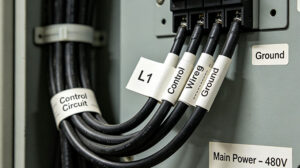
In the rigorous worlds of electrical engineering, telecommunications, and heavy manufacturing, a mislabeled or unidentified wire is more than just a minor inconvenience—it is a critical safety hazard and a massive drain on maintenance hours. While standard adhesive wire wraps work for basic office environments, they are fundamentally inadequate for harsh industrial conditions.
To achieve permanent, fail-safe cable identification, professionals rely on a dedicated heat shrink label printer. By printing directly onto heat-shrinkable tubes that permanently encase the wire, this technology ensures your identification outlasts the equipment itself. Here is a comprehensive guide to understanding the use cases, material durability, and how to select the right hardware for your facility.
Industry Pain Points: The Failure of Standard Adhesives
Facility managers and assembly line engineers face unique environmental challenges that rapidly destroy standard paper or vinyl adhesive labels:
- Heat and Thermal Cycling:When routing cables for high-density setups—like the internal chassis of industrial USB hardware, including heavy-duty charging stations and multi-port USB servers—cables generate significant heat. Standard adhesives melt, causing labels to slide or unwrap completely.
- Chemical and Fluid Exposure:In automotive and aerospace manufacturing, wires are constantly exposed to hydraulic fluids, oils, and harsh cleaning solvents that quickly erase standard ink.
- Physical Abrasion:Cables pulled through tight conduits or subjected to constant vibration will experience severe friction, physically scraping off conventional printed tags.
- Strict Safety Audits:Industrial setups must comply with stringent regulations (such as UL standards or military specifications). Faded or missing wire markers lead to immediate audit failures and costly rework.
The Superiority of Heat Shrink Label Materials
To survive these extremes, a heat shrink label printer utilizes thermal transfer technology. A heated printhead melts durable, resin-based ink directly onto a flattened polyolefin tube.
- The Shrink Ratio:Once printed and slipped over the wire, a heat gun is applied. The polyolefin material typically features a 2:1 or 3:1 shrink ratio, meaning it shrinks to half or one-third of its original diameter, tightly gripping the wire’s insulation.
- Total Encapsulation:Because it is a continuous sleeve rather than an adhesive sticker, a heat shrink tube cannot unpeel. It acts as an extra layer of insulation, providing unmatched resistance to abrasion, moisture, and extreme temperatures.
- Legibility and Compliance:The resin ink bonds permanently with the polyolefin substrate, ensuring that safety codes, batch numbers, and barcodes remain crystal clear for decades.
Paced Workflows and Print Efficiency
For field technicians and assembly line workers, time is money. A commercial-grade heat shrink label printer drastically optimizes workflows:
- Automated Cutting Mechanisms:Premium industrial models feature programmable “half-cut” functionality. The printer cuts the tube just enough to separate the individual markers while keeping them attached to a continuous carrier strip. Technicians can print an entire sequence of wire markers, carry the strip to the installation site, and snap them off one by one.
- High-Speed Batch Printing:Instead of manually typing each tag, engineering teams can import Excel spreadsheets directly into the printer’s software to mass-produce sequential serial numbers and complex barcodes instantly.
Selecting the Right Heat Shrink Label Printer
Upgrading your industrial identification system requires matching the hardware to your operational environment:
- Desktop vs. Portable:For high-volume manufacturing lines or panel building shops, a heavy-duty desktop thermal transfer printer is ideal. For field electricians repairing existing infrastructure, a rugged, battery-powered portable unit is essential.
- Print Resolution (DPI):If you are working with very thin gauge wires (like fiber optics or internal circuitry), prioritize a printer with a 300 DPI printhead to ensure tiny text and dense 2D barcodes remain perfectly legible.
- Open Media Ecosystem:Keep your Total Cost of Ownership (TCO) low by selecting a printer that accepts standard, third-party bulk rolls of heat shrink tubing, rather than expensive, proprietary cartridges.
Ensure Absolute Reliability with Detonger
Substandard labeling jeopardizes your infrastructure and slows down critical maintenance. By integrating professional thermal transfer printing technology with high-grade polyolefin tubing, you guarantee that your wire identification is as robust as the systems they power.
With over 16 years of unified R&D and manufacturing excellence, Detonger builds industrial-grade labeling solutions tailored for the most demanding environments. Our versatile printers deliver high-speed performance, deep software integration, and rugged durability to keep your engineering teams moving.
Ready to upgrade your wire marking system for permanent reliability?
[Ask for Industrial Labeling Solution]
Contact our hardware specialists today to discuss your specific cabling environment and receive tailored equipment recommendations.