
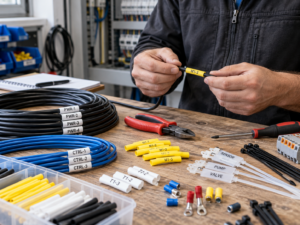
A portable cable label printer is a mission-critical, industrial-grade thermal device engineered for electrical contractors, network engineers, and telecom technicians who need to generate highly durable, compliant identification markers directly at the installation site. When selecting this hardware, B2B buyers must prioritize three uncompromising specifications: thermal transfer printing technology (to guarantee resistance against heat and friction), a 300 DPI printhead (for legibility on micro-wires), and versatile media handling (the ability to print on heat shrink tubing, self-laminating wraps, and flag tags). Decision-makers should evaluate their crew’s daily workflow: if your technicians are wasting billable hours walking back and forth to a site trailer to reprint faded tags from a desktop laser printer, deploying a high-resolution, Bluetooth-enabled portable thermal printer is a necessary operational upgrade.
Why Centralized Printing Fails in Electrical Contracting
In legacy workflows, project managers often batch-print hundreds of wire markers on A4 sticker sheets using a standard office laser printer before the crew heads to the job site. This rigid process breaks down the moment it meets the reality of field installation.
If an architect alters a panel schematic on the fly, or if a technician drops a pre-printed tag into a dusty conduit trench, the installation halts. The worker must leave the server room or electrical closet, walk to the command center, retype the data, and reprint the label. Furthermore, standard laser toner is notoriously brittle; when standard paper labels are wrapped around a tightly curved Cat6a wire, the toner flakes off and the paper tears.
A portable cable label printer entirely decentralizes this process. By equipping field technicians with a battery-powered device they can wear on a toolbelt, they can generate custom, serialized, and indestructible markers exactly at the point of installation.
The Practical Buyer’s Checklist
Standard consumer-grade label makers will produce tags that peel, fade, or blur within months. To secure hardware that passes strict building code inspections, buyers must verify the following technical capabilities:
- Thermal Transfer Technology (Mandatory):Never buy a direct thermal printer for electrical work. Direct thermal labels darken when exposed to heat. Inside a hot server rack or a high-voltage industrial panel, direct thermal labels will turn completely black, erasing all text. You must select a thermal transfer label printer. This technology melts a solid resin ribbon into a synthetic plastic tag, creating an archival-quality marker that resists hydraulic oil, UV rays, and extreme conduit temperatures.
- 300 DPI Print Resolution:Electrical labels require dense formatting. You must often fit phase identifiers, destination ports, and micro QR codes onto a tiny 12mm flag tag. A standard 203 DPI printer will blur this micro-text. A 300 DPI printhead is strictly required to ensure zero ambiguity during future maintenance.
- Drop-In Consumable Cassettes:Field workers operating on ladders or in cramped crawlspaces cannot waste time manually threading loose ribbons around tiny internal spools. Prioritize hardware that utilizes sealed, one-piece consumable cassettes (which house both the resin ribbon and the synthetic label roll together) for foolproof, instant reloading.
Matching the Hardware to the Media
Your chosen printer must possess the mechanical versatility to handle the three fundamental types of electrical media:
| Cable Label Type | Best Application | Hardware Requirement |
| Self-Laminating Wraps | Cat6/Cat6a cables, coaxial drops, thick power cords | Requires a wider print capacity (up to 36mm or 50mm) to allow the clear transparent tail to wrap over and seal the printed text. |
| Polyolefin Heat Shrink Tubing | Internal panel wiring, terminal blocks, aviation | Requires a pure resin ribbon and high printhead pressure to ensure the text survives the heat-gun shrinking process. |
| P-Type/T-Type Flag Tags | Fiber optic jumpers, ultra-thin wiring | Requires highly precise transmissive sensors to align the fold perfectly, creating a flat, scannable surface for a 2D barcode. |
Expert Hardware Recommendations from Detonger
Selecting the appropriate unit requires matching the machine’s maximum print width to the thickest cable gauge your team handles. Detonger provides purpose-built, ISO9001-certified hardware engineered specifically for the telecommunications and electrical sectors.
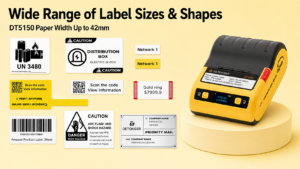
Detonger DT5150: The Ultimate Toolbelt Companion
For network engineers, AV installers, and commercial electricians, the Detonger DT5150 1.5-inch All-in-One Thermal Transfer Printer is the optimal portable solution.
- Why it excels in the field:Outputting at a highly precise 300 DPI, it ensures micro-text on tiny fiber flags remains flawless. It supports label widths up to 36mm, effortlessly accommodating standard Cat6 self-laminating wraps and narrow heat shrink tubing. Its smart drop-in cassette system allows technicians to swap between adhesive wraps and non-adhesive tubing in seconds without exposing the internal mechanics to drywall dust.
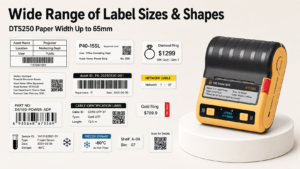
Detonger DT5250: The Heavy-Duty Industrial Wire Marker
For master electricians, substation engineers, and industrial panel builders dealing with massive multi-conductor power trunks, the Detonger DT5250 offers an expanded 2.5-inch capacity.
- Why it excels in the field:Accommodating label widths up to 63mm, this heavy-duty portable printer generates large wrap-around markers for massive power cables and prominent breaker panel directories. Equipped with a high-capacity 2600 mAh battery, it sustains continuous batch-printing throughout long commercial shifts.
Automating the Workflow with Weprint Software
Rugged field hardware is useless if the software creates bottlenecks. Detonger portable printers integrate seamlessly with our proprietary Weprint app, accessible on iOS and Android smartphones.
Weprint empowers project managers to eliminate manual typing errors. Using the app’s advanced serialization tool, technicians can automatically generate sequential wire numbers (e.g., L1-01 through L1-99) with a single tap. For massive commercial build-outs, users can import complete cable schedules directly from an Excel spreadsheet via their smartphone, batch-printing hundreds of flawless, formatted labels right at the server rack.
Investing in a professional, portable cable label printer is a strategic maneuver that drastically reduces labor time, prevents catastrophic miswiring, and ensures your installations pass regulatory inspections on the first attempt. Equip your field technicians with the best tools available by exploring our comprehensive Cable Label Printer for Wire, Electrical and Heat Shrink Labels collection, or discover our complete Durable Wire & Cable Label Printing Solutions today.
Frequently Asked Questions (FAQs)
Q: Do I need an internet connection on the job site to print labels?
A: No. Portable cable label printers connect to your smartphone or tablet via a direct Bluetooth connection. As long as the Weprint app is installed and your Excel schedules are cached on your device, you can design, sequence, and print tags deep inside a concrete basement or underground conduit where cellular service is entirely unavailable.
Q: Why do the labels I print smear when I pull the wire through a conduit?
A: You are likely using a consumer-grade label maker equipped with a wax ribbon, or you are using standard paper labels. To survive conduit friction and pulling lubricants, you must use an industrial thermal transfer printer equipped with a pure resin ribbon. Resin permanently fuses into synthetic materials (like vinyl or PET), creating an impenetrable, scratch-proof bond.
Q: Can one portable printer handle both adhesive labels and non-adhesive heat shrink tubes?
A: Yes. A versatile machine like the Detonger DT5150 is designed to handle both formats. You simply remove the cassette containing self-laminating adhesive labels and drop in a cassette containing heat shrink tubing. The printer’s internal sensors automatically calibrate to the new media format.