
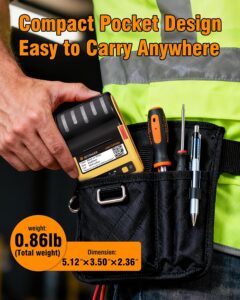
A handheld label maker is a portable, battery-powered printing device designed to create durable, on-demand identification tags, barcodes, and text labels directly at the point of work. It is built for small business owners, field technicians, warehouse supervisors, and retail managers who require efficient, mobile labeling without being tied to a desktop computer. The primary factors to consider when choosing a unit include the print technology (direct thermal for low-cost operational speed versus thermal transfer for extreme outdoor longevity), label width capacity (ranging from narrow 12mm tags to wide 4-inch shipping labels), print resolution (203 DPI vs. 300 DPI), and wireless mobile app connectivity. Users should evaluate their typical work environment and the required label lifespan to determine whether an inkless direct thermal model or a rugged, resin-ribbon thermal transfer system fits their workflow.
Why Handheld Label Makers Are Essential for Modern Businesses
In today’s fast-paced commercial and industrial sectors, stationary labeling stations create workflow bottlenecks. Requiring staff to return to a central office every time a price changes, a cable is rerouted, or a sample is collected wastes valuable labor hours.
A professional handheld label maker decentralizes this process by placing an entire labeling station into the palm of an operator’s hand. With modern Bluetooth and Wi-Fi connectivity, employees can generate serialized barcodes, warehouse bin markers, asset tags, and compliance labels directly where the physical task occurs. This on-the-spot printing workflow minimizes labeling errors, speeds up inventory audits, and ensures immediate compliance with industry standards.
Key Selection Factors for a Handheld Label Maker
Choosing the ideal portable printing solution requires matching the technical specifications of the device with your organization’s specific operational requirements.
1. Print Technology: Direct Thermal vs. Thermal Transfer
The printing method dictates the operational cost, maintenance requirements, and longevity of your labels:
- Direct Thermal:Utilizes heat-sensitive paper that darkens when heated by the printhead. It requires no ink, toner, or ribbons, making it lightweight and budget-friendly for indoor retail, standard shipping, and temporary organization.
- Thermal Transfer:Uses a heated printhead to melt a solid ink ribbon onto synthetic label materials (such as PET, PVC, or polyolefin heat shrink tubing). This creates waterproof, scratch-resistant, and UV-proof markers designed to last 5 to 10+ years outdoors or in industrial settings.
2. Print Resolution (DPI)
Print resolution determines text clarity and barcode scannability:
- 203 DPI:The industry standard for bold text, simple shipping barcodes, and standard price tags.
- 300 DPI:Essential for small-footprint labeling, such as high-density 2D DataMatrix codes, tiny jewelry tags, laboratory vials, and narrow telecommunication wire markers.
3. Media Width and Form Factor Versatility
Different applications demand different label widths. Compact units typically support 12mm to 15mm continuous tapes for simple bin labeling, while 2-inch (58mm) and 3-inch (80mm) models are suited for retail shelf edges and asset tracking. For full-sized shipping labels and chemical compliance tags, wide-format portable models supporting up to 104mm or 210mm are required.
4. Software Ecosystem and Data Integration
Hardware performance is maximized when backed by intuitive software. Modern portable printers should connect seamlessly to iOS and Android smartphones via Bluetooth, support PC connections via USB, and offer cloud template synchronization. Features like direct Excel data imports are vital for batch-printing sequential numbers without repetitive manual entry.
Direct Thermal vs. Thermal Transfer Comparison
The table below outlines the core differences between the two primary technologies used in portable label makers:
| Feature / Metric | Direct Thermal Handheld Label Maker | Thermal Transfer Handheld Label Maker |
| Print Mechanism | Heat-sensitive paper darkens when heated | Heated printhead melts a ribbon onto the label |
| Consumables Required | Thermal label rolls only | Synthetic label rolls AND ribbon cassettes |
| Durability & Resistance | Moderate (Sensitive to prolonged UV/heat) | Extreme (Water, oil, scratch, and chemical proof) |
| Print Lifespan | 6 to 12 months (indoor environments) | 5 to 15+ years (indoors and outdoors) |
| Cost per Label | Lower operational cost | Moderate to higher (requires two consumables) |
| Primary Applications | Retail price tags, food dates, shipping waybills | Asset tags, wire markers, industrial equipment |
For businesses focused primarily on fast-turnaround indoor retail, food packaging, or short-term logistics, direct thermal models provide an economical, ink-free option. For electrical engineering, laboratory specimens, and fixed asset management, thermal transfer hardware is required to maintain permanence.
Detonger Product Recommendations for 2026
Detonger brings 16 years of independent research, design, and manufacturing expertise to portable printing, supported by ISO9001, CE, and FCC certifications and 11 invention patents. Depending on your operational requirements, Detonger offers specialized models tailored to diverse commercial workflows.
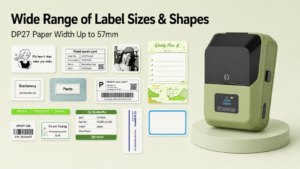
Best for Retail and Commercial Mobility: Detonger DP27 Series
For retail boutiques, supermarkets, and mobile field workers needing an agile direct thermal device, the Detonger DP27 Series is a top-tier choice.
- Key Features:Weighing under 300g, this 2-inch printer supports label widths up to 57mm. It features a bright TFT screen for instant parameter verification and offers both 203 DPI and high-resolution 300 DPI (DP27P) configurations.
- Application:Ideal for apparel swing tags, supermarket price stickers, and shelf-edge labels.
Best for Heavy-Duty Industrial Identification: Detonger DT5250
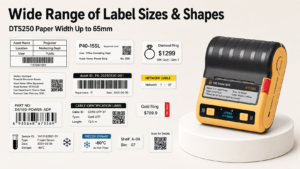
When applications demand maximum durability, such as asset tracking and electrical panel identification, the Detonger DT5250 All-in-One Thermal Transfer Printer delivers industrial-grade performance in a handheld format.
- Key Features:Accommodating print widths up to 61mm at 300 DPI, the DT5250 utilizes an innovative one-piece consumable cassette that combines the ribbon and synthetic label (such as Silver PET or PVC) into a single drop-in cartridge. Powered by a high-capacity 2600 mAh battery, it prints crisp, scannable QR codes that resist friction, moisture, and chemical exposure.
- Application:Perfect for telecom cable labeling, fixed asset management, and laboratory sample tracking.
Streamlining Operations with Weprint Software
Detonger’s proprietary Weprint software links hardware with enterprise workflows. Available across iOS, Android, and Windows, Weprint enables mobile workers to access pre-designed cloud templates, generate dynamic barcodes and QR codes, and import large datasets directly from Excel for rapid batch printing.
Additionally, Detonger offers Software Development Kits (SDKs) across Android, iOS, and Windows, enabling enterprises to integrate these portable printers directly into existing ERP, WMS, or POS systems.
Selecting the Right Solution for Your Business
Investing in the right handheld label maker reduces manual labor, eliminates pricing and inventory discrepancies, and ensures full compliance across field and facility operations. By assessing your required label lifespan, daily print volume, and resolution needs, you can select hardware that delivers consistent return on investment.
Explore our dedicated Portable Label Printer and Handheld Label Maker for Small Business collection, check out our inkless thermal label printer lineup for high-speed commercial tagging, or review our specialized Cable Label Printer for Wire, Electrical and Heat Shrink Labels to equip your team with reliable mobile printing tools.
Frequently Asked Questions (FAQs)
Q: What is the main operational difference between an all-in-one consumable cassette and a split-type system?
A: An all-in-one consumable cassette integrates the ribbon and the label roll into a single pre-aligned cartridge, allowing users to swap supplies in seconds without manually feeding ribbons around the printhead. A split-type system houses the ribbon and label roll separately, offering greater customization over ribbon formulations (wax, wax-resin, pure resin) at high production volumes.
Q: Can a handheld label maker print without an active internet connection?
A: Yes. Modern handheld label makers connect directly to smartphones or tablets via local Bluetooth. Templates saved locally within mobile apps (like Weprint) can be edited and printed entirely offline in remote field locations or subterranean server rooms.
Q: How do I determine if my application requires 203 DPI or 300 DPI resolution?
A: A 203 DPI print resolution is suitable for standard text, large price digits, and standard 1D linear barcodes (such as UPC or Code 128). If your labels require 2D DataMatrix codes, complex corporate logos, or small-font technical specifications (under 6pt) placed on narrow surfaces, 300 DPI is strongly recommended to prevent scanning failures.