
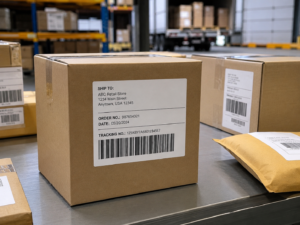
A waterproof label printer is a vital industrial tool utilized by warehouse managers, 3PL logistics providers, and e-commerce shippers to produce weather-resistant 4×6 tracking waybills. It is specifically designed for enterprises whose packages endure rain, snow, or high-condensation environments during global transit. The most critical selection factor is the printer’s maximum print width—which must accommodate industry-standard 4-inch (104mm) shipping labels—paired with the correct thermal technology. Users should initially judge their requirements by assessing their outdoor exposure and dispatch volume. If your shipments sit on open-air loading docks or travel cross-border, investing in a robust 4-inch portable thermal device loaded with top-coated synthetic media is strictly required to ensure tracking barcodes never smudge, fade, or peel before reaching the customer.
The Cost of Ignoring Waterproofing in Logistics
In the high-volume shipping sector, a barcode is the only link between your warehouse and the customer. When companies rely on standard paper labels printed via standard inkjet or laser machines, moisture becomes a catastrophic liability. A few drops of rain or condensation from a refrigerated truck can cause standard ink to bleed and paper to disintegrate.
This results in unreadable waybills, leading to delayed shipments, misrouted packages, and expensive manual data overrides at sorting facilities. A dedicated waterproof label printer eliminates this supply chain vulnerability. By utilizing heat to activate specialized coatings on thermal paper—or melting resin onto synthetic substrates—these printers create high-contrast, indestructible shipping labels that guarantee first-pass scanning regardless of the weather.
Crucial Specifications for Shipping Hardware
When procuring hardware for a bustling logistics hub, B2B decision-makers must look beyond basic functionality. A reliable waterproof label printer must possess specific industrial capabilities to handle the rigors of modern freight.
- 4-Inch Print Width (The Industry Standard):Major carriers like FedEx, UPS, DHL, and USPS standardize their waybills on the 4×6 inch (100x150mm) format. A printer with a maximum width of 2 or 3 inches cannot print compliant shipping labels. You must ensure the hardware supports at least a 104mm effective print width.
- Media Compatibility (The Source of Waterproofing):The printer itself does not make the label waterproof; the consumables do. The hardware must be able to calibrate and print on “three-proof” (waterproof, oil-proof, scratch-proof) direct thermal labels or synthetic thermal transfer rolls (like PP or PET).
- Battery Autonomy for Mobile Printing:Efficiency drops when warehouse staff must walk back and forth to a stationary printing desk. Portable devices equipped with high-capacity lithium-ion batteries (minimum 2500 mAh) empower forklift operators to print waterproof tags directly at the pallet.
- Wireless Connectivity & API Integration:The printer must integrate with your Warehouse Management System (WMS). Look for devices offering Bluetooth/Wi-Fi connectivity and robust SDKs, allowing for automated batch printing directly from mobile picking devices.
Printing Technologies for Waterproof Shipping
To choose the right hardware, logistics managers must compare how different thermal technologies achieve water resistance:
| Feature / Metric | Direct Thermal (with 3-Proof Labels) | Thermal Transfer (with Resin Ribbon) |
| Print Mechanism | Heated printhead activates chemical paper | Heated printhead melts a ribbon onto the label |
| Waterproofing Method | Top-coated chemical barrier on the paper | Indestructible resin fused to synthetic plastic |
| Durability Level | High (Repels rain, snow, and condensation) | Extreme (Survives prolonged chemical/water submersion) |
| Consumables Required | Three-proof direct thermal label rolls only | Synthetic label rolls AND a resin ribbon |
| Operational Speed | Very Fast (Ideal for rapid dispatch) | Moderate (Requires precise ribbon alignment) |
| Ideal Shipping Use Case | Standard e-commerce, courier transit, air freight | Heavy machinery shipping, ocean freight, hazardous goods |
For 95% of standard logistics operations, a direct thermal printer paired with premium three-proof waterproof labels is the most agile and cost-effective choice.
Expert Hardware Recommendations from Detonger
Selecting the appropriate unit requires matching the machine’s width capacity and battery performance to your daily dispatch volume. Detonger, an established manufacturer with 16 years of independent R&D experience, global ISO/CE/FCC certifications, and 11 invention patents, provides purpose-built hardware for the logistics sector.
Detonger DP40 Series: The Ultimate Mobile Shipping Tool
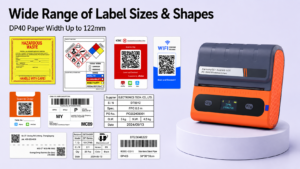
For fast-paced warehouse environments, 3PL providers, and e-commerce fulfillment centers, the Detonger DP40 Series is the optimal portable solution.
- Why it fits shipping:As a 4/4.5-inch direct thermal label printer, the DP40 supports label widths up to 114mm (with a 104mm effective print width), perfectly accommodating the standard 4×6 waybill format. When loaded with three-proof direct thermal labels, it produces crisp 203 DPI barcodes that easily repel rain and handling oils.
- Logistics-Centric Engineering:Weighing under 500g and equipped with dual 2600 mAh batteries, warehouse staff can carry it effortlessly throughout an entire shift, yielding approximately 120 meters of continuous printing. It bypasses the need for messy ink, ensuring maximum operational uptime.
Streamlining Dispatch with Intelligent Software
Hardware durability must be supported by intelligent software to eliminate manual data entry bottlenecks. Detonger printers integrate seamlessly with our proprietary Weprint software ecosystem, available on iOS, Android, and PC.
Weprint allows dispatch managers to import daily shipping manifests directly from Excel. Staff can automatically map spreadsheet columns (recipient name, address, tracking number) to generate hundreds of serialized shipping labels in minutes. For enterprise logistics, we provide robust SDK and API access, allowing developers to embed our printing protocols directly into your proprietary ERP or shipping platforms.
Upgrading your fulfillment center with a dedicated waterproof label printer ensures every package reaches its destination without barcode scanning failures. To future-proof your dispatch operations, explore our comprehensive Shipping Label Printer for E-commerce, Warehouse and Logistics models, or implement our complete Efficient Warehouse Label Printing ecosystem today.
Frequently Asked Questions (FAQs)
Q: Do I need to buy special ink to make my shipping labels waterproof?
A: No. Thermal printers do not use liquid ink or toner. If you use a direct thermal printer (like the DP40), the heat activates a coating in the paper to create the image; you simply need to purchase “three-proof” (waterproof) direct thermal labels. If you use a thermal transfer printer, the waterproof resin is embedded in a dry ribbon cartridge.
Q: Is the adhesive on the back of the label also waterproof?
A: Not automatically. While the printed surface of a three-proof thermal label resists water, you must ensure the label roll you purchase features a “hot-melt” or “freezer-grade” acrylic adhesive if your packages will sit in pooling water or freezing conditions, preventing the label from physically peeling off the cardboard.
Q: Can I use standard, non-waterproof thermal paper in these printers during an emergency?
A: Yes. The hardware will print perfectly fine on standard, economy direct thermal labels. However, those labels will turn black if exposed to high heat or will smudge if they get wet. The waterproofing capability relies entirely on the quality of the consumable label roll you load into the machine.