
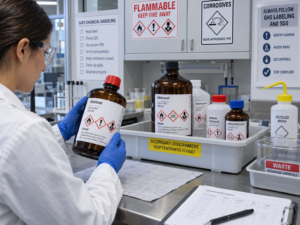
A GHS compliant label printer is an industrial-grade thermal printing device specifically engineered for chemical manufacturers, safety officers, and facility managers to generate highly durable, legally mandated hazard warning labels on demand. The most critical selection factors include the core print technology (thermal transfer is mandatory for extreme chemical and UV resistance), media compatibility (handling synthetic substrates required for BS5609 maritime certification), and precise sensor calibration to align black text within pre-printed red hazard diamonds. Users should initially judge their requirements by evaluating their container sizes and transit routes: if you are dispatching 55-gallon drums or intermediate bulk containers (IBCs) overseas, deploying a wide-format thermal transfer printer loaded with pure resin ribbons is an absolute operational necessity to ensure critical hazard data survives saltwater, solvent spills, and intense UV exposure.
The Critical Importance of GHS Compliance in Chemical Workplaces
The Globally Harmonized System (GHS) and regional safety protocols (such as OSHA in the US or REACH in Europe) mandate strict standardization for chemical hazard communication. A non-compliant, illegible, or degraded label is not merely a logistical inconvenience—it is a severe safety hazard that can trigger massive regulatory fines, supply chain embargoes, and workplace injuries.
Standard consumer inkjet or office laser printers are dangerously inadequate for chemical facilities. Their inks dissolve instantly upon contact with industrial solvents, and standard paper completely disintegrates under outdoor weathering. A dedicated GHS compliant label printer circumvents these vulnerabilities by utilizing specialized thermal heat to fuse industrial resin directly into the pores of synthetic plastics (like PET or PVC). This creates an impenetrable, permanent marker. Whether a chemical drum sits in a sun-baked outdoor storage yard for years or accidentally leaks highly corrosive solvent down its side, the printed signal words, precautionary statements, and hazard pictograms will remain 100% intact.
Essential Specifications for Chemical Labeling Hardware
Procuring hardware for chemical manufacturing requires a strict focus on industrial endurance and regulatory format requirements. B2B decision-makers must evaluate printers based on the following specific capabilities:
- Thermal Transfer Print Technology:True chemical compliance often requires meeting the BS5609 standard for international maritime transport. This dictates the exclusive use of a thermal transfer label printer. By melting a pure resin ribbon onto specialized synthetic substrates, the device creates an ultra-durable bond that actively resists acetone, xylene, extreme UV exposure, and prolonged saltwater submersion.
- Precise Reflective and Transmissive Sensors:GHS regulations mandate that hazard pictograms must feature a prominent red diamond border. Because industrial thermal printers typically operate in monochrome (black), chemical facilities utilize label rolls that are pre-printed with blank red diamonds. Your printer must possess advanced media sensors to perfectly align the black hazard symbols and text inside these pre-printed red borders at high speeds.
- Adjustable Wide-Format Capacity:GHS label dimensions are legally tied to container volume. While a standard 2-inch printer works for a small laboratory jug, labeling a bulk chemical drum legally requires massive 4×4 inch or 6×6 inch labels. Your hardware fleet must include wide-format models to accommodate these diverse legal requirements.
- High Print Resolution (300 DPI):Chemical labels must often condense extensive first-aid instructions, multiple languages, and complex tracking barcodes into a limited surface area. A 300 DPI printhead ensures that dense micro-text and 2D DataMatrix codes remain perfectly sharp, preventing misinterpretation by handlers.
Direct Thermal vs. Thermal Transfer in Chemical Environments
To fully understand why specific hardware is mandated for chemical safety, compare how the two primary thermal technologies withstand industrial abuse:
| Feature / Metric | Direct Thermal Printing | Thermal Transfer Printing (with Resin) |
| Print Mechanism | Heat-sensitive chemical paper darkens | Heated printhead melts a resin ribbon onto the label |
| Consumables Needed | Direct thermal labels only | Synthetic labels AND a pure resin ribbon |
| Chemical & Solvent Resistance | Low (Easily erased by chemical spills and wiping) | Extreme (Impervious to harsh industrial solvents) |
| BS5609 Maritime Compliance | No (Fails saltwater submersion tests) | Yes (When paired with certified synthetic labels and ribbons) |
| Print Lifespan | 6 to 12 months in controlled conditions | 10 to 15+ years in harsh outdoor environments |
| Ideal Chemical Application | Short-term internal waste transport tags | Permanent chemical drum tagging, international shipping |
For any hazardous product leaving a controlled facility, thermal transfer technology is the only legally and operationally sound choice.
Expert Recommendations: Top Detonger GHS Label Printers
Selecting the appropriate unit requires matching the hardware’s print width and consumable capacity to your specific container sizes. Detonger provides purpose-built hardware for the industrial sector, backed by 16 years of independent R&D and global CE/FCC certifications.
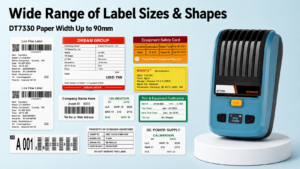
Detonger DT7330: For Intermediate Bulk Containers & Jugs
If your chemical facility manages 5-gallon buckets, large chemical jugs, and intermediate containers, the Detonger DT7330 offers an optimal 3-inch wide-format capacity.
- Why it fits GHS compliance:This heavy-duty split-type printer is engineered specifically for wide equipment and industrial asset labels. By separating the ribbon roll from the label roll, it allows safety officers to load high-capacity BS5609-certified synthetic label stock and premium resin ribbons. This setup guarantees that extensive precautionary statements and multiple GHS pictograms are securely affixed to intermediate containers at the lowest possible cost-per-print.
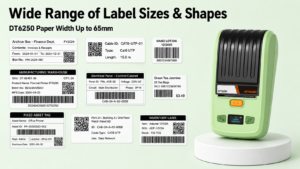
Detonger DT6250: For Laboratory Vials & Small Chemical Bottles
For chemical laboratories, pharmaceutical cleanrooms, and facilities managing smaller hazardous sample bottles, the Detonger DT6250 provides precision 2.5-inch printing.
- Why it fits GHS compliance:Outputting at a highly precise 300 DPI, it ensures that microscopic safety text and dense chemical tracking barcodes are flawlessly rendered on small curved surfaces. It handles the specialized Matte Silver PET tags required for long-term corrosive sample storage, ensuring compliance even on the smallest containers.
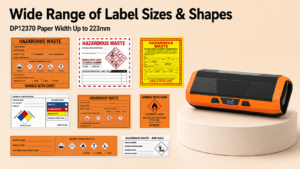
Detonger 8-Inch Thermal Printers: For 55-Gallon Drums
For massive IBC totes and 55-gallon bulk chemical drums, facilities must utilize an 8-inch wide-format industrial printer.
- Why it fits GHS compliance:These wide-format devices accommodate the massive 6×6 inch and 8×8 inch label formats legally required for bulk hazardous transport. They ensure that all signal words, hazard statements, and supplier identifiers are visible from a distance, protecting warehouse staff and dock workers.
Automating Safety Protocols with Weprint Software
Hardware reliability must be driven by intelligent software to eliminate deadly manual data entry errors. Detonger printers integrate natively with the proprietary Weprint software ecosystem, available on iOS, Android, and PC.
Weprint enables safety managers to design standardized, locked GHS templates, ensuring all mandatory hazard statements and pictograms comply perfectly with OSHA regulations. Floor technicians can import daily production manifests directly from Excel, allowing them to automatically generate hundreds of serialized, highly accurate chemical tags in minutes.
Investing in a dedicated GHS compliant label printer is a critical risk management strategy that protects your workforce and shields your enterprise from catastrophic regulatory penalties. Upgrade your facility’s safety infrastructure today by exploring our heavy-duty Industrial Label Printer for Manufacturing, Warehouse and Durable Labels collection, or browse our enterprise-grade Manufacturing & Industrial Labeling Industrial Label Printing Solutions to secure your chemical supply chain.
Frequently Asked Questions (FAQs)
Q: Can a standard thermal printer print the red GHS hazard diamonds?
A: Standard industrial thermal printers operate in monochrome (usually printing in black resin). To achieve GHS compliance, chemical facilities purchase synthetic label rolls that are pre-printed with blank red diamond borders. The printer then uses precise transmissive and reflective sensors to align and print the black hazard symbols and text exactly inside those pre-printed red areas.
Q: What is BS5609 certification, and why does my printer need it?
A: BS5609 is an internationally recognized standard for printed labels used on chemical containers transported by sea. It requires the printed label to survive three months submerged in saltwater without peeling or fading. The hardware printer itself is not certified; rather, the certification is granted to the specific combination of the synthetic label material, the pure resin ribbon, and the thermal transfer printing process.
Q: Do I need a computer on the loading dock to print GHS labels?
A: Not necessarily. Modern industrial printers and portable units offer Bluetooth and Wi-Fi connectivity. Safety officers can use mobile apps like Weprint on an industrial tablet or smartphone to pull up locked GHS templates from a cloud database and print them directly at the loading dock, minimizing the risk of applying the wrong label to a drum during transit.