
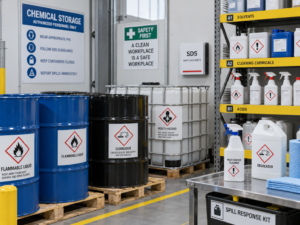
A GHS compliant label printer is a heavy-duty, industrial thermal printing device specifically engineered for chemical manufacturers, Environmental Health and Safety (EHS) officers, and facility managers to produce indestructible hazard warning labels. The most critical features that matter when selecting this hardware include the core printing mechanism (thermal transfer is legally mandatory to achieve extreme chemical and UV resistance), highly precise media sensors (to perfectly align black text within pre-printed red hazard diamonds), and 300 DPI resolution (to render dense precautionary statements legibly). Users should initially judge their requirements by evaluating their container sizes and transport routes: if your chemical drums are shipped internationally by sea, you must deploy a wide-format thermal transfer printer paired with synthetic substrates and pure resin ribbons to ensure the final printed tag achieves BS5609 maritime certification.
The High Stakes of Chemical Hazard Communication
The Globally Harmonized System (GHS) requires strict standardization in how chemical hazards are communicated across borders. A non-compliant, faded, or dissolving label represents a severe safety hazard that can result in massive regulatory fines, denied international shipments, and tragic workplace accidents.
Standard consumer inkjet and desktop laser printers are completely unsuited for chemical manufacturing floors. Standard inkjet ink dissolves instantly upon contact with industrial solvents, and typical paper labels disintegrate under outdoor weathering or warehouse friction. A dedicated GHS compliant label printer bypasses these vulnerabilities by utilizing focused heat to melt industrial-grade resin directly into the pores of synthetic plastics (such as PET, PVC, or specific polypropylenes). This creates a permanent, impenetrable marker. Whether a chemical tote is subjected to a prolonged saltwater journey on a cargo ship or suffers an accidental xylene spill, the printed signal words, precautionary text, and hazard pictograms will remain 100% intact.
What Features Matter Most in a GHS Compliant Label Printer?
Procuring hardware for hazardous environments requires an uncompromising focus on material science and machine precision. B2B decision-makers must evaluate printers based on these essential capabilities:
- Thermal Transfer Print Technology (Resin Compatibility):GHS compliance for maritime shipping requires meeting the rigorous BS5609 standard, which dictates that a label must survive three months submerged in saltwater. This can only be achieved using a thermal transfer label printer loaded with a pure resin ribbon. The printer must possess adequate printhead pressure to fuse this high-temperature resin into specialized synthetic label rolls.
- Precision Media Sensors for Red Diamond Registration:GHS regulations mandate that hazard pictograms feature a prominent red diamond border. Because industrial thermal printers typically operate in monochrome (black), chemical facilities buy synthetic label rolls pre-printed with blank red diamonds. The printer must feature advanced transmissive (gap) and reflective (black mark) sensors to perfectly align the black hazard symbols and text inside these pre-printed red borders at high speeds without shifting.
- 300 DPI High-Resolution Printheads:Chemical labels must condense extensive first-aid instructions, multi-language hazard warnings, supplier identification, and complex tracking barcodes into limited surface areas. A standard 203 DPI printer will blur dense micro-text and 2D DataMatrix codes. A 300 DPI printhead is mandatory to ensure all safety data remains perfectly crisp and unambiguous to handlers.
- Adjustable Wide-Format Capability:GHS label dimensions scale with container volume. A 2-inch printer suffices for a small laboratory sample vial, but legally tagging a 55-gallon bulk drum requires a massive 4×4 inch or 6×6 inch label. Your printing hardware must feature adjustable media guides to accommodate these diverse, legally mandated widths.
Hardware Comparison: Standard vs. GHS Chemical Printing
Understanding the operational differences between generic hardware and purpose-built chemical printers highlights why standard IT procurement fails in the chemical sector:
| Feature / Metric | Standard Office Printer (Inkjet/Laser) | Dedicated GHS Compliant Label Printer |
| Print Technology | Liquid ink or baked toner on paper | Heated resin ribbon melted into synthetic plastic |
| Chemical & Solvent Resistance | Zero (Erased instantly by acetone, xylene, etc.) | Extreme (Impervious to harsh industrial solvents) |
| BS5609 Maritime Viability | Fails (Disintegrates in water) | Passes (When used with certified resin and synthetic stock) |
| Media Handling | Standard A4 or letter paper | Thick synthetic rolls with pre-printed red diamonds |
| Expected Label Lifespan | Months (Indoors only) | 10 to 15+ years (In harsh outdoor/marine environments) |
For any chemical product leaving a controlled facility, investing in specialized thermal transfer hardware is the only legally and financially responsible decision.
Top Detonger Printers for Chemical Labeling
Selecting the appropriate unit involves matching the hardware’s print width to your facility’s container sizes. Detonger provides purpose-built, highly durable hardware designed specifically for heavy industry and compliance marking.
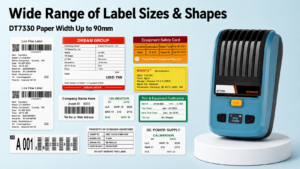
Detonger DT7330: For IBCs and Chemical Jugs
If your chemical facility manages 5-gallon pails, large chemical jugs, and Intermediate Bulk Containers (IBCs), the Detonger DT7330 offers an optimal 3-inch wide-format capacity.
- Why it fits GHS workflows:This heavy-duty split-type printer allows safety officers to independently load high-capacity BS5609-certified synthetic label stock and premium resin ribbons. Its advanced sensor array ensures black text is perfectly centered within pre-printed red hazard diamonds, securing massive precautionary statements to intermediate containers at the lowest possible cost-per-print.
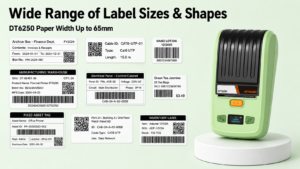
Detonger DT6250: For Laboratory Vials and Sample Bottles
For pharmaceutical cleanrooms, R&D laboratories, and facilities dispatching smaller hazardous sample bottles, the Detonger DT6250 provides precision 2.5-inch printing.
- Why it fits GHS workflows:Outputting at a highly precise 300 DPI, it ensures that microscopic safety text and dense chemical tracking barcodes are flawlessly rendered on small curved surfaces. It handles the specialized Matte Silver PET tags required for long-term corrosive sample storage, guaranteeing compliance even on the smallest diagnostic vials.
Ensuring Accuracy with Weprint Software Integration
Industrial-grade hardware must be driven by locked, intelligent software to eliminate deadly manual data entry errors. Detonger printers integrate natively with the proprietary Weprint software ecosystem, accessible on iOS, Android, and PC.
Weprint empowers EHS managers to design standardized, locked GHS templates that perfectly match regulatory layouts. Instead of typing out complex chemical names and hazard codes manually, floor technicians can use the software’s Excel import tool to upload daily production manifests. The system automatically pulls the correct signal words, pictograms, and hazard statements for each SKU, batch-printing hundreds of serialized, flawlessly accurate chemical tags in minutes.
Investing in a dedicated GHS compliant label printer protects your workforce, prevents costly shipping embargoes, and shields your enterprise from catastrophic regulatory penalties. Upgrade your facility’s compliance infrastructure today by exploring our heavy-duty Industrial Label Printer for Manufacturing, Warehouse and Durable Labels collection, or browse our enterprise-grade Manufacturing & Industrial Labeling Industrial Label Printing Solutions to secure your hazardous supply chain.
Frequently Asked Questions (FAQs)
Q: Does the printer itself have BS5609 certification?
A: No, printers themselves are not BS5609 certified. BS5609 is an internationally recognized durability standard for labels transported by sea. The certification applies to the specific combination of the synthetic label material, the pure resin ribbon, and the thermal transfer print process. A high-quality thermal transfer printer provides the necessary heat and pressure to fuse these certified materials together successfully.
Q: How do thermal printers produce the red and black colors required for GHS labels?
A: Most industrial thermal transfer printers operate in monochrome (printing a single color, usually black, from a resin ribbon). To achieve the red and black GHS requirement cost-effectively, chemical manufacturers purchase synthetic label rolls that are pre-printed with empty red diamond borders. The printer’s advanced sensors detect these borders and print the black hazard pictograms and text precisely inside them.
Q: Can I use direct thermal labels for short-term chemical storage?
A: While direct thermal labels (which require no ribbon) are highly convenient for temporary logistics, they are strictly prohibited for hazardous chemical labeling. Direct thermal paper is highly sensitive to heat, UV light, and chemical contact; exposure to a minor solvent spill or a hot warehouse will cause the entire label to turn black, destroying the safety information instantly.