
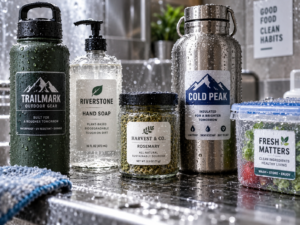
A waterproof label printer is a compact, commercial-grade thermal device designed for small business owners, artisan manufacturers, and boutique retailers to produce moisture-resistant, highly durable packaging and identification tags on demand. The most critical selection factors for growing enterprises are the underlying print technology (thermal transfer is absolutely essential for extreme water and oil resistance), media compatibility (handling synthetic substrates like Silver PET or flexible PVC), and high-resolution output (300 DPI for micro-text). Small business operators should initially judge their requirements by evaluating their product’s lifecycle and storage conditions. If your inventory involves refrigerated craft beverages, essential oils, or outdoor nursery plants, a portable thermal transfer printer loaded with resin ribbons is mandatory to ensure your branding and barcodes survive condensation, handling friction, and temperature fluctuations.
Why Small Businesses Must Abandon Standard Printers
For a small business launching a new product line or organizing a local warehouse, relying on standard office inkjet or laser printers is a costly operational mistake. Water-based inkjet inks smear instantly when a customer touches a cold, wet bottle, and standard paper labels disintegrate in refrigerated storage. Outsourcing to commercial print shops is equally problematic, as it forces startups into high Minimum Order Quantities (MOQs), resulting in wasted inventory if an ingredient list changes.
Bringing a dedicated waterproof label printer in-house decentralizes your packaging and inventory workflow. By utilizing specialized thermal technology, these devices melt industrial pigments directly into synthetic plastics. This creates a permanent, waterproof, and oil-proof marker. Whether you are generating 50 labels for a limited-batch hot sauce, tagging frozen meat packages, or identifying outdoor storage bins, this hardware ensures your branding remains pristine and your barcodes remain 100% scannable without the overhead of third-party printing delays.
Key Selection Criteria for Waterproof Labeling
Small business decision-makers must evaluate hardware based on technical durability, material flexibility, and cost-efficiency rather than just cosmetic design.
- Thermal Transfer Print Technology:To achieve true, long-lasting waterproofing, you must utilize a thermal transfer label printer. Unlike direct thermal printing (which relies on heat-sensitive paper that can darken over time), thermal transfer uses a heated printhead to melt a solid resin or wax-resin ribbon onto a synthetic label. This forms an impenetrable chemical bond that actively repels water, alcohol, and cosmetic oils.
- High-Resolution Output (300 DPI):Small businesses must often fit extensive regulatory text, ingredient lists, and dynamic QR codes onto very small surfaces (like a lip balm tube or a 1-inch product barcode). A 300 DPI (Dots Per Inch) printhead guarantees that microscopic text and dense 2D matrices possess razor-sharp edge definition, eliminating scanning failures at the retail checkout.
- Industrial Substrate Compatibility:Your hardware must reliably feed and print on synthetic label rolls. Look for printers equipped with precise transmissive and reflective sensors capable of calibrating Matte Silver PET, PP (polypropylene), and flexible PVC materials, which are inherently waterproof and tear-resistant.
- Mobile Form Factor:Small businesses rarely have dedicated packing facilities. Portable, battery-powered units allow entrepreneurs to design and print rugged labels directly on the retail counter, the warehouse floor, or the production workbench via smartphone connectivity.
Direct Thermal vs. Thermal Transfer for Small Business
Understanding how different thermal mechanisms react to moisture will save your business from costly packaging failures:
| Feature / Metric | Direct Thermal (with 3-Proof Paper) | Thermal Transfer (Resin on Synthetic) |
| Print Mechanism | Heated printhead activates chemical coating | Heated printhead melts a resin ribbon onto the label |
| Water Resistance | Moderate (Withstands light splashes/condensation) | Extreme (Survives total, prolonged submersion) |
| Oil & Chemical Tolerance | Low (Fades upon contact with oils/solvents) | Exceptional (Impervious to essential oils and cleaning chemicals) |
| Consumables Needed | 3-Proof Direct Thermal Labels only | Synthetic Labels AND a thermal transfer ribbon |
| Ideal Small Biz Use | Short-term cold chain, temporary outdoor tagging | Cosmetics, frozen foods, outdoor plants, durable asset tags |
For any product containing liquids, essential oils, or facing long-term freezing/outdoor exposure, thermal transfer is the only scientifically sound choice to prevent data loss and brand degradation.
Expert Hardware Recommendations: Top Detonger Models
Selecting the appropriate unit requires matching the hardware’s print width and consumable architecture to your specific business operations. Detonger provides purpose-built, durable hardware tailored for small enterprise workflows.
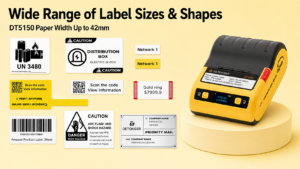
- Detonger DT5150 (Compact Asset & QR Labels):For boutique cosmetics, handmade jewelry, and small IT asset tracking, this 1.5-inch printer is the optimal agile solution. It features an innovative one-piece consumable cassette, pre-loading the resin ribbon and synthetic label together. It is perfect for generating waterproof QR codes and ingredient lists on small vials and compact electronics.
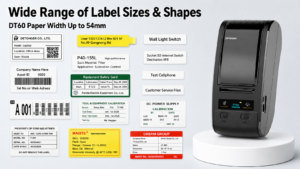
- Detonger DT60 (Durable Asset & Inventory Labels):This 2-inch split-type printer is built for small business inventory items, storage assets, and long-lasting identification. By separating the ribbon roll from the label roll, growing businesses can cost-effectively produce waterproof identification tags for warehouse bins and cold-storage food packaging at a lower cost-per-print.
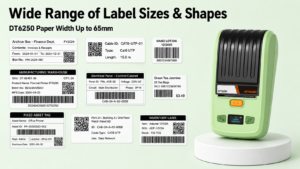
- Detonger DT6250 (Professional Asset Tracking Labels):Stepping up to a 2.5-inch print width, this device is engineered for professional asset management and wider product packaging. It easily handles the wider synthetic tags required for artisan craft beer bottles, skincare jars, and detailed outdoor equipment logs.
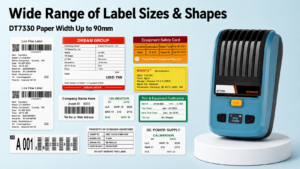
- Detonger DT7330 (Wide Equipment & Industrial Asset Labels):For small contractors, rental businesses, or bulk food packagers, this printer offers a superior 3-inch wide-format capacity. It is specifically recommended for large equipment IDs, heavy machinery labels, and wide-format durable identification that must survive extreme weather or high-pressure washing.
Streamlining Production with Weprint Software
Hardware precision must be paired with dynamic design software to eliminate manual data entry bottlenecks. Detonger printers integrate natively with our proprietary Weprint software ecosystem, accessible on iOS, Android, and PC.
Weprint allows brand owners to design custom, weather-proof labels incorporating dynamic dates, complex tables, and high-density 2D barcodes. The software supports direct Excel data imports, enabling you to automatically batch-print hundreds of serialized waterproof tags, varying weights, and expiration dates in minutes.
Investing in a dedicated waterproof label printer is a strategic maneuver that elevates your brand’s perceived value, secures your physical assets, and provides infinite packaging flexibility. By prioritizing thermal transfer technology and utilizing smart batch-printing software, your small business operations will withstand any environment. To scale your labeling capabilities, explore our robust Industrial Label Printer for Manufacturing, Warehouse and Durable Labels collection today.
Frequently Asked Questions (FAQs)
Q: Do I need to buy a special type of ink to ensure my labels are truly waterproof?
A: No. Thermal printers do not use liquid ink. If you require true waterproofing, you will use a thermal transfer printer equipped with a solid pure resin ribbon. The printhead melts this resin into a synthetic label (like PET or PVC) at high temperatures, creating a bond that is completely impervious to water, oil, and chemical solvents.
Q: Can I use waterproof labels on products that are stored in a commercial freezer?
A: Yes, but the printed surface is only half the equation. While a thermal transfer label is waterproof, standard adhesives will freeze, crystallize, and fall off in sub-zero temperatures. You must ensure you purchase synthetic label rolls equipped with a “cold-grade” or “freezer-grade” acrylic adhesive to prevent the waterproof label from physically peeling off the frozen packaging.
Q: Can a small business waterproof label printer print in full color?
A: No. Commercial thermal label printers operate in monochrome (printing in a single color, usually black, though colored resin ribbons exist). To achieve full-color waterproof packaging, small businesses typically purchase pre-printed colorful synthetic label rolls from a supplier, and then use their in-house thermal printer to overprint variable black text (such as batch numbers, dates, and barcodes) into designated blank areas.