
A plant label printer is a rugged, industrial-grade thermal device designed for nursery owners, garden center managers, and agricultural researchers to produce durable, weather-resistant identification tags for flora. The most critical selection factors include the printing technology (thermal transfer is absolutely essential to prevent UV fading and water damage), substrate compatibility (the ability to print on thick PVC stakes or flexible wrap-around tags), and hardware portability for on-site greenhouse tagging. Users should initially judge their needs by assessing their growing environment. If your inventory is stored outdoors, subjected to daily overhead watering, or exposed to intense direct sunlight, a portable thermal transfer printer paired with resin ribbons is strictly required to ensure that plant names, care instructions, and pricing barcodes remain legible across changing seasons.
The Essential Role of a Plant Label Printer in Horticulture
In the horticulture and landscaping industry, accurate labeling is critical for inventory management and customer education. Standard office inkjet or laser printers are completely ineffective for this sector; their inks run instantly when exposed to moisture, and paper labels disintegrate in humid greenhouse environments.
A dedicated plant label printer resolves this by bringing industrial-grade durability directly to the potting shed or greenhouse aisle. By utilizing specialized thermal technology, these devices melt industrial resin onto synthetic, non-porous substrates, creating a permanent marker. This allows nurseries to generate on-demand custom labels for seasonal batches, eliminating the overhead of ordering pre-printed tags in bulk and ensuring that every plant carries accurate, scannable data from the moment it is potted until it reaches the retail customer.
Key Specifications When Evaluating a Plant Label Printer
Procuring hardware for a nursery requires a strict focus on outdoor durability and media versatility. B2B decision-makers should evaluate the following critical specifications:
- Print Technology for Maximum Endurance:To survive the elements, your chosen hardware must be a thermal transfer label printer. This technology uses a heated printhead to melt a solid resin ribbon into the surface of a synthetic tag. This creates an impenetrable, waterproof layer that actively repels soil, fertilizer chemicals, and prolonged UV exposure.
- Media Versatility and Thickness:Nurseries do not just use standard adhesive stickers. A professional plant label printer must be able to feed and print on rigid PVC push-in stakes (pot stakes) and flexible wrap-around loop tags for tree branches. Ensure the printer’s media guides and printhead pressure can accommodate thicker synthetic materials.
- Print Resolution (300 DPI):Plant labels must often condense a large amount of data—such as scientific binomial names, watering icons, sunlight requirements, and retail barcodes—onto a very narrow stake. A 300 DPI (Dots Per Inch) printhead guarantees that intricate care icons and tiny text remain perfectly crisp and scannable.
- Portability and Battery Life:Moving hundreds of potted plants to a central office to be labeled is highly inefficient. Portable devices equipped with high-capacity lithium batteries (2500 mAh or higher) empower staff to print durable tags directly in the field, saving countless labor hours.
Thermal Transfer vs. Direct Thermal for Plant Nurseries
To make an informed purchasing decision, it is vital to understand how printing methods react to outdoor environments.
| Feature / Metric | Direct Thermal Printing | Thermal Transfer Printing |
| Print Mechanism | Heat-sensitive paper darkens when heated | Heated printhead melts a resin ribbon onto the label |
| Water & Mud Resistance | Low to Moderate | Extreme (Can be washed or submerged) |
| UV & Sunlight Resistance | Very Low (Turns entirely black in the sun) | Excellent (Remains legible for years outdoors) |
| Consumables Needed | Direct thermal labels only | Synthetic tags AND a resin ribbon |
| Ideal Nursery Application | Temporary indoor retail receipts | PVC stakes, wrap-around tags, outdoor pots |
| Operating Cost | Lower (No ribbons to purchase) | Higher (Requires two separate consumables) |
For any botanical application involving outdoor storage, watering, or sunlight, thermal transfer is the only scientifically sound choice to prevent your tracking barcodes from disappearing.
Expert Recommendations: Top Detonger Plant Label Printers
Selecting the specific hardware model requires matching the machine’s capabilities to your nursery’s physical layout and tag dimensions. Detonger, an established manufacturer with 16 years of independent R&D experience, global ISO/CE certifications, and 11 invention patents, offers purpose-built hardware for the agricultural sector.
Detonger DT5250: The Agile 2.5-Inch Nursery Tool
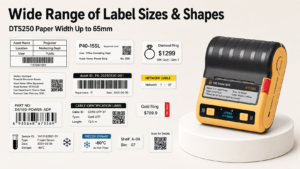
For boutique garden centers, arborists, and research greenhouses, the Detonger DT5250 All-in-One Thermal Transfer Printer is the optimal portable solution.
- Why it fits plant labeling:Outputting at a sharp 300 DPI, it ensures that small QR codes and dense care instructions look flawless. It accommodates print widths up to 61mm, making it perfect for standard wrap-around tree tags and medium-sized adhesive pot stickers. Its innovative one-piece consumable cassette pre-loads the resin ribbon and synthetic label rolls together, allowing your staff to reload the printer in the middle of a muddy greenhouse without threading delicate ribbons.
Detonger DT5330: For Wide-Format Stakes and Pots
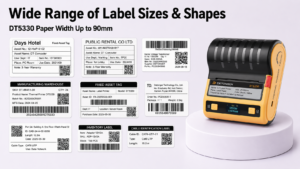
If your wholesale nursery utilizes large display pots or wide PVC stakes that require prominent branding, the Detonger DT5330 offers a wider 3.3-inch print capacity.
- Why it fits plant labeling:This device can handle wide-format synthetic tags, allowing you to print prominent, high-contrast retail pricing alongside detailed plant care graphics. Equipped with a high-capacity 2600 mAh battery, it empowers your field workers to execute massive batch-printing jobs across acres of inventory without needing a power outlet.
Streamlining Inventory with Weprint Software
Hardware precision must be paired with intelligent software to manage diverse botanical inventories. Detonger printers integrate seamlessly with our proprietary Weprint software ecosystem, available on iOS, Android, and PC.
Weprint allows nursery managers to design custom templates incorporating specialized plant care icons, complex tables, and high-density barcodes. More importantly, the software supports direct Excel data imports. Instead of manually typing out the complex botanical names for 50 different species of Hosta, a manager can import their weekly planting spreadsheet and automatically batch-print hundreds of unique, serialized plant tags in minutes.
Cultivate a More Efficient Nursery Today
Investing in a high-quality plant label printer is a strategic operational upgrade that eliminates the massive costs associated with faded tags, lost inventory identification, and third-party printing delays. By prioritizing 300 DPI thermal transfer technology, selecting rugged synthetic substrates, and utilizing smart batch-printing software, your nursery operations will run seamlessly across every season.
Ready to secure your botanical inventory? Explore our purpose-built Industrial Label Printer for Manufacturing, Warehouse and Durable Labels collection to find the perfect heavy-duty hardware for your greenhouse today.
Frequently Asked Questions (FAQs)
Q: Can a plant label printer print on both sides of a PVC stake?
A: Standard portable thermal transfer printers are single-sided devices. If you need information on both sides of a rigid PVC stake, the standard operational procedure is to print a highly durable, waterproof adhesive synthetic label and apply it to the back of a pre-printed, branded stake, or apply labels to both sides.
Q: Do I need to buy special ink to ensure my plant tags don’t fade in the sun?
A: You do not buy liquid ink; you must purchase a pure resin ribbon. When used in a thermal transfer printer, the resin is melted directly into the synthetic plant tag. Resin is highly UV-resistant and waterproof, ensuring the text and barcodes survive prolonged exposure to direct sunlight and heavy watering.
Q: What is the difference between a wrap-around tag and a pot stake?
A: A wrap-around tag (or loop tag) is a flexible synthetic strip designed to loop around the branch of a tree or shrub and lock into itself without using adhesive. A pot stake (or push-in tag) is a rigid piece of PVC or thick plastic with a pointed end that is driven directly into the soil of a potted plant. A versatile printer can handle the thickness of both media types.