
A qr barcode label printer configured for sequential numbering is an indispensable tool for manufacturing plants, distribution warehouses, asset management teams, and clinical research facilities. Unlike static label printing where identical codes are mass-produced, sequential number labeling requires hardware and software capable of advancing alphanumeric values incrementally—whether generating ascending serial numbers, serialized lot IDs, or dynamic two-dimensional matrices—without stalling production lines. The most critical selection criteria for sequential barcode generation include a 300 DPI high-resolution printhead to ensure micro-modules remain legible as code density increases, thermal transfer capability for long-term physical durability, and robust batch-processing software to automate serialization rules without manual intervention.
The Critical Role of Sequential Numbering in Modern Operations
Sequential numbering forms the operational backbone of automated supply chains, asset tracking, quality assurance, and compliance workflows. When tracking capital equipment, pharmaceutical vials, or sub-assemblies on a manufacturing line, every item requires an entirely unique digital and physical identity.
Legacy methods—such as manually entering serial numbers, printing batch sheets on standard office laser printers, or ordering pre-numbered rolls from commercial print shops—introduce severe operational bottlenecks. Manual entry invites catastrophic typographical errors, while office laser labels peel and fade under heat or handling. Furthermore, pre-printed rolls leave zero room for unexpected quantity changes or variable production schedules.
Deploying an industrial qr barcode label printer solves these challenges by combining dynamic code generation with on-demand physical output. Driven by smart serialization algorithms, the printer dynamically updates each tag’s 1D barcode, 2D QR code, and human-readable text in real time. This ensures complete traceability across ERP and WMS platforms while eliminating duplicate tags and human entry errors.
Key Technical Specifications for Sequential Barcode Printing
Generating sequential 1D and 2D barcodes at commercial scale requires specialized hardware engineering:
- 300 DPI Printhead Resolution:As sequential values scale up (e.g., advancing from numeric values like 001 to complex alphanumeric strings like SN-2026-US-984421-B), the corresponding QR code or DataMatrix module matrix expands and becomes denser. A standard 203 DPI printhead will cause these shifting micro-modules to bleed together, resulting in scan failures under optical imagers. A 300 DPI printhead maintains crisp cell boundaries and maximum contrast regardless of variable string length.
- Thermal Transfer vs. Direct Thermal Versatility:Your choice of thermal technology must match the lifecycle of the serial number. For temporary tracking—such as internal cross-docking or courier transit—inkless direct thermal paper provides maximum cost efficiency. For permanent equipment tagging or compliance tracking lasting 5 to 10+ years, your hardware must support thermal transfer technology, melting pure resin ribbon into synthetic substrates (like Matte Silver PET) to resist abrasion, solvents, and UV light.
- Onboard Buffer Memory & High-Speed Data Processing:Sequential printing demands that the printer process a unique image for every single label rather than repeating a cached graphic. The printer must possess sufficient internal RAM and high-speed processing architecture to continuously render dynamic 2D codes without pausing between labels.
- Accurate Gap and Black-Mark Registration:Sequential rolls cannot afford drift. The printer requires sensitive transmissive (gap) and reflective (black mark) media sensors to calibrate the start and end of every label precisely, ensuring serial text and barcodes stay centered across thousands of consecutive prints.
Comparing Thermal Print Technologies for Serialized Labels
| Evaluation Metric | Direct Thermal Printing | Thermal Transfer Printing (Resin Ribbon) |
| Imaging Mechanism | Heat activates chemical facestock coating | Printhead melts solid resin into synthetic film |
| Consumable Configuration | Direct thermal label roll only (no ribbon) | Synthetic label roll (PET/PVC) + resin ribbon |
| Environmental Resilience | Moderate (sensitive to heat, UV, and friction) | Extreme (impervious to water, oil, and chemicals) |
| Typical Data Lifespan | 6 to 12 months (indoor controlled storage) | 5 to 15+ years (harsh industrial environments) |
| Running Cost | Lowest consumable cost per label | Moderate (two separate consumables) |
| Recommended Application | Short-term courier waybills, daily retail batches | Fixed asset tracking, PCB serial tags, medical vials |
Recommended Detonger Models for Sequential Barcode Labeling
Detonger leverages 16 years of independent research, global ISO9001 certifications, and 11 invention patents to deliver precision hardware tailored for dynamic and serialized data printing.
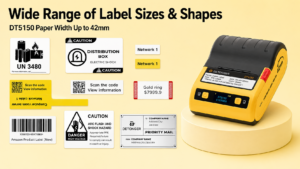
Detonger DT5150: The Compact Serialized Asset Specialist
For IT infrastructure, electronics manufacturing, laboratory sample tracking, and small-parts serialization, the Detonger DT5150 1.5-inch All-in-One Thermal Transfer Printer delivers unmatched precision.
- Why it excels for sequential codes:Outputting at a sharp 300 DPI, the DT5150 renders microscopic 2D DataMatrix and QR codes on narrow labels down to 15mm without module distortion. It features a sealed, one-piece consumable cassette that loads both the resin ribbon and synthetic Silver PET labels in a single step. Technicians can execute automated sequential asset runs right at the workbench or server rack using smartphone Bluetooth connectivity.
Detonger DT6250: Multi-Format Industrial Serialization Workhorse
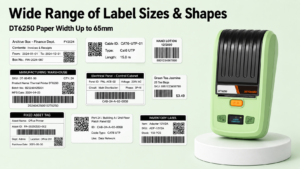
For warehouse inventory, industrial component manufacturing, and equipment compliance tracking, the Detonger DT6250 provides expanded width and flexibility.
- Why it excels for sequential codes:Supporting media widths up to 61mm (2.5 inches) at 300 DPI, the DT6250 provides ample printable area to display sequential 1D linear barcodes alongside complex 2D QR codes and human-readable serial numbers. Its split-type consumable design separates the ribbon from the label roll, drastically lowering the cost-per-print for high-volume serial production runs.
Detonger DP40 Series: High-Volume Mobile Logistics Champion
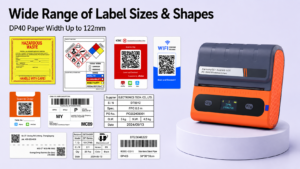
For logistics dispatch, distribution centers, and pallet serialization, the Detonger DP40 Series handles wide-format sequential tasks on the go.
- Why it excels for sequential codes:Accommodating media widths up to 114mm (with a 104mm effective print width), the DP40 outputs standard 4×6 inch serialized shipping labels and sequential pallet IDs. Powered by dual 2600 mAh battery packs, logistics workers can walk loading docks and batch-print consecutive carrier labels directly at the pallet.
Automating Sequential Data with WePrint Software
A high-precision qr barcode label printer requires intelligent software to eliminate the need for manual numbering entry. Detonger hardware integrates natively with the WePrint application across iOS, Android, and Windows PC.
WePrint features built-in dynamic serialization tools that streamline high-volume numbering:
- Rule-Based Counter Sequencing:Users can configure auto-incrementing rules (e.g., start at 1001, step by 1, pad with leading zeros, or cycle prefixes like LOT-A-). Both the human-readable text and the corresponding QR code update synchronously on each printed label.
- Excel & CSV Database Integration:For complex or non-linear serial numbers, users can import external spreadsheets directly. WePrint automatically maps database columns to the label template, generating sequential barcodes with zero manual transcription.
- Enterprise SDK Integration:For automated production lines, Detonger provides multi-platform SDKs that allow enterprise software engineers to send direct serialized print commands from internal ERP, MES, or WMS systems.
Deploying a dedicated qr barcode label printer eliminates duplicate numbers, streamlines physical inventory audits, and establishes end-to-end operational traceability. Explore our complete Barcode Label Printer for Warehouse, Inventory and Asset Tracking collection and discover high-efficiency Thermal Transfer Label Printer options to upgrade your labeling workflow today.
Frequently Asked Questions (FAQs)
Q: Can a qr barcode label printer generate both a sequential 1D barcode and a sequential QR code on the same label?
A: Yes. Professional labeling software like WePrint allows you to place multiple dynamic elements on a single canvas. You can bind both a 1D barcode (such as Code 128) and a 2D QR code to the same incremental rule or spreadsheet column, ensuring both formats advance synchronously on every printed tag.
Q: What causes sequential QR codes to fail scanning when the serial number gets larger?
A: When a serial number string expands in length, the QR code algorithm adds more rows and columns of microscopic black-and-white modules to encode the extra characters. On a lower-resolution 203 DPI printer, these shrinking modules often bleed together, blurring cell boundaries. Using a 300 DPI printer ensures that high-density, alphanumeric QR codes retain sharp geometry and immediate scannability.
Q: Do I need an active internet connection to print sequential serial labels from a mobile phone?
A: No. The WePrint application processes serialization rules locally on your iOS or Android device. Once your template and sequence parameters are configured (or your spreadsheet is downloaded), the phone generates the dynamic print data and transmits it to the printer via local Bluetooth, allowing seamless operation inside warehouses, server basements, and remote job sites.