
An industrial heat shrink label printer and a wrap-around cable label printer represent the two foundational approaches to wire and cable identification across electrical, aerospace, telecommunications, and industrial automation sectors. While both systems are engineered to generate durable, legible alphanumeric wire markers, circuit numbers, and machine-readable barcodes, their physical form factors, installation mechanics, and substrate properties address fundamentally different stages of the wiring lifecycle. A heat shrink sleeve printer outputs continuous, non-adhesive polyolefin tubing that must be slipped over bare wire ends prior to terminal crimping and recovered with an industrial heat gun. In contrast, a wrap-around cable label printer utilizes self-adhesive, self-laminating vinyl or polyester wraps that can be applied to terminated conductors and active cabling retroactively. The decisive hardware selection criteria include wire lifecycle stage (OEM assembly vs. live field maintenance), electrical insulation demands (600V dielectric breakdown requirements), environmental exposure (fuel, abrasion, and extreme thermal cycling), and printhead resolution (300 DPI to render micro-typography and dense DataMatrix codes). Electrical engineers and panel shop supervisors must evaluate their assembly workflows: if your shop builds new control cabinets, harness assemblies, or military-spec equipment requiring permanent, zero-slip insulation sleeves, deploying a dedicated thermal transfer heat shrink printer is an indispensable operational investment.
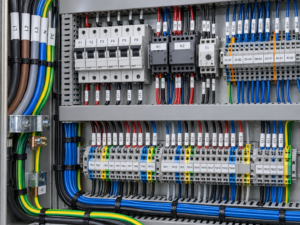
The Physical and Operational Distinctions: Heat Shrink vs. Wrap-Around
Understanding the trade-offs between sleeve printing and wrap-around labeling requires examining their material science, mechanical attachment, and downstream performance under stress:
1. Attachment Mechanics and Workflow Sequencing
- Heat Shrink Sleeving (Pre-Termination Mandatory):Heat shrink tubing consists of continuous, hollow, cross-linked polyolefin. It must be mechanically threaded over the conductor before terminal lugs, spade connectors, or pin headers are crimped into place. Once heated with a heat gun (typically between 120°C and 250°C), the sleeve contracts radially down to 50% (2:1 shrink ratio) or 33% (3:1 shrink ratio) of its original inner diameter, locking flush against the conductor insulation. It cannot be retrofitted to pre-wired, terminated harnesses without de-pinning or cutting the connector.
- Wrap-Around Labels (Pre- or Post-Termination Flexibility):Wrap-around markers—most notably self-laminating vinyl or flexible polyester—feature a pressure-sensitive adhesive backing. Technicians wrap the label directly around the cable jacket. A clear, unprinted laminate tail wraps completely over the white printable legend, sealing the printed text under a transparent protective barrier. These can be installed at any point in the system lifecycle, making them the industry standard for field servicing, retrofit tracing, and active patch panel additions.
2. Environmental and Chemical Resilience
- Heat Shrink Performance:Because polyolefin sleeves shrink tightly around the wire without relying on chemical adhesives, they eliminate adhesive failure modes such as adhesive creep, oozing, or embrittlement. They deliver superior physical abrasion resistance, chemical immunity to aviation fuels, hydraulic fluids, and severe mechanical vibration, while providing auxiliary dielectric insulation up to 600V.
- Wrap-Around Performance:Modern self-laminating vinyl features high-tack acrylic adhesives that bond permanently to smooth PVC, Teflon, or silicone cable jackets. The clear overlaminate provides mechanical protection against moisture, grease, and finger oils. However, in environments with extreme solvent baths, persistent hydraulic oil saturation, or continuous temperatures above 105°C, adhesives can soften over multi-year cycles compared to cross-linked polyolefin.
Detailed Comparison: Heat Shrink Printer vs. Wrap-Around Printer
| Engineering Dimension | Heat Shrink Label Printer | Wrap-Around Cable Label Printer |
| Media Substrate | Continuous flattened cross-linked polyolefin tubing | Die-cut self-laminating vinyl or flexible polyester film |
| Attachment Mechanism | Radial thermal contraction (heat gun required) | High-tack pressure-sensitive acrylic adhesive |
| Workflow Timing | Pre-termination only (prior to lug/crimp install) | Pre- or post-termination (anytime in lifecycle) |
| Dielectric Insulation | Yes (flame-retardant, rated up to 600V) | No (identification marker only; non-insulating) |
| Slip & Vibration Resistance | Maximum (360° mechanical lock; zero slippage) | High (dependent on cable jacket diameter and adhesive) |
| Post-Print Processing | Requires industrial heat gun activation | Peel and hand-wrap directly onto wire |
| Curved Surface Tension | None (sleeve forms a seamless cylindrical band) | High (requires flexible film to prevent edge-flagging) |
| Typical Industrial Applications | Aerospace harnesses, control cabinets, OEM machinery | Data center patch bays, field maintenance, telecom racks |
When to Choose a Heat Shrink Label Printer
Deploying a dedicated heat shrink label printer is strictly mandatory when engineering specifications prioritize permanent structural bonding, regulatory electrical insulation, and severe-duty performance:
- OEM Switchgear and Control Cabinet Manufacturing:High-volume industrial control panel builders prioritize clean aesthetics, compact bundle spacing, and compliance with UL 508A and NFPA 79 standards. Heat shrink sleeves provide a smooth, cylindrical profile that will not catch on wire ducts or peel away inside densely packed terminal blocks.
- Military, Aerospace, and Rail Harnesses (Mil-Spec Compliance):Military and aviation wire assemblies (governed by standards like SAE-AS81531 and MIL-STD-202G) require zero-slip identifiers capable of surviving intense vibration, turbine oils, and hydraulic fuels. Cross-linked polyolefin sleeves printed with pure resin ribbons fulfill these requirements permanently.
- High-Vibration Machinery and Motor Feeds:In stamping presses, agricultural machinery, and automotive powertrain harnesses, constant mechanical shock causes wrap-around label tails to catch and tear. Heat shrink tubing forms a single, contiguous sheath that moves with the conductor.
When to Choose a Wrap-Around Cable Label Printer
A wrap-around cable marking system is the superior operational choice when agility, retrofit capability, and variable cable diameters dominate:
- Live Field Maintenance and Retrofit Audits:When tracing, repairing, or labeling legacy electrical panels, data centers, or telecom closets where disconnecting critical terminal terminations causes unacceptable operational downtime, self-laminating wrap-around labels are the only viable solution.
- Fiber Optic and Structured Telecom Cabling:Fiber optic patch cords, twisted-pair Cat6A cables, and high-density coaxial lines carry fragile internal glass cores or sensitive foil shielding that cannot tolerate the heat blast of an industrial heat gun. Wrap-around adhesive tags apply cold, eliminating all thermal risks to sensitive network cabling.
- Wide Cable Diameter Ranges:A single roll of self-laminating wrap-around labels with an extended clear tail can accommodate a wide span of outer cable diameters (e.g., from 4mm up to 12mm), whereas heat shrink tubing requires matching specific sleeve diameters and expansion ratios to specific wire gauges.
Core Hardware Specifications to Look For in Wire Labeling Hardware
Whether choosing sleeving or adhesive wraps, commercial electrical marking hardware must meet rigorous mechanical and optical standards:
1. Thermal Transfer Printing Architecture with Pure Resin Ribbons
Direct thermal printing cannot be used for wire labeling; heat guns, server exhaust, or engine heat instantly blacken direct thermal coatings. The equipment must be a dedicated thermal transfer label printer capable of driving pure resin ribbons. The printhead melts solid resin polymers directly into the polyolefin tubing or vinyl facestock, forming an indelible bond resistant to abrasion, moisture, and chemical solvents.
2. 300 DPI Ultra-High Resolution Output
Wire identification requires fitting wire numbers, circuit phase codes, source/destination data, and micro-barcodes onto narrow 15mm to 36mm widths. A 203 DPI printhead utilizes 0.125mm dots that cause 3pt and 4pt text to blur and micro-2D DataMatrix modules to bleed together. A 300 DPI (Dots Per Inch) printhead delivers fine 0.084mm dot pitch, ensuring razor-sharp typography and verified barcode quiet zones for instant optical scanning.
3. High-Torque Drive and Heavy-Duty Cutting Mechanisms
Flattened polyolefin heat shrink tubing is significantly thicker (0.4mm to 0.8mm dual-wall) than flat adhesive vinyl, creating substantial mechanical drag against feed rollers. The printer must incorporate high-torque stepper motors, high-durometer vulcanized platen rollers, and hardened tool-steel guillotine cutters capable of executing thousands of full-cuts and partial half-cuts (perforations) without dulling or jamming.
Recommended Detonger Models for Electrical Wire Marking
Detonger leverages 16 years of independent hardware research, global ISO9001/CE certifications, and 11 invention patents to deliver robust thermal hardware tailored for panel building, wire harness fabrication, and field telecom maintenance.
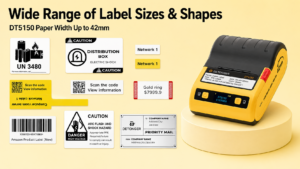
Detonger DT5150: The Dual-Capability Mobile Electrical Specialist
For industrial electricians, control panel wiremen, and field technicians requiring versatility across both heat shrink sleeving and self-laminating wraps, the Detonger DT5150 1.5-inch All-in-One Thermal Transfer Printer delivers benchtop precision in a handheld footprint.
- Why it excels for wire marking:Featuring a 300 DPI printhead, the DT5150 outputs microscopic text, schematic symbols, and 2D DataMatrix codes on continuous polyolefin heat shrink tubing, self-laminating cable wraps, and Matte Silver PET labels up to 36mm wide. Its sealed, all-in-one consumable cassette houses both the resin ribbon and media roll inside a single cartridge, allowing technicians to switch between heat shrink tubing and wrap-around labels in seconds with zero manual ribbon threading. Equipped with long-life battery power and Bluetooth connectivity, electricians can print serialized wire markers directly inside control cabinets.
Detonger DT5250: Heavy-Duty Industrial Harness Workhorse
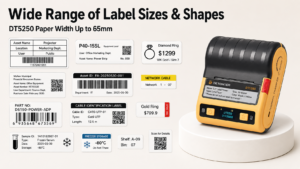
For switchgear manufacturing facilities, automation machine builders, and power substation contractors processing heavy-gauge power feeds and large daily harness batches, the Detonger DT5250 provides expanded media capability.
- Why it excels for wire marking:Supporting media widths up to 63mm (2.5 inches) at 300 DPI, the DT5250 easily feeds large-diameter 3:1 and 2:1 continuous polyolefin heat shrink tubing for multi-conductor industrial cables as well as wide-format self-laminating vinyl sheets. Its heavy-duty drive mechanics transport thick flattened tubing without slippage, while its split-type architecture substantially reduces per-marker consumable costs during high-volume production shifts.
Streamlining Wire Schedules with WePrint Software
Both heat shrink and wrap-around labeling require intelligent design and database software to eliminate manual data entry bottlenecks. Detonger hardware integrates natively with the WePrint application across iOS, Android, and Windows PC.
WePrint optimizes wire marking workflows through specialized features:
- Rule-Based Serialization:Technicians can configure automated incrementation rules for sequential wire numbers (e.g., TB1-001 through TB1-500) with custom step values, phase prefixes, and leading zero padding.
- Excel & CAD Wire Schedule Synchronization:Import complex wire run lists and point-to-point interconnect tables directly from Excel (.xlsx) or CSV manifests. WePrint automatically maps conductor source, destination, and wire ID columns into pre-calibrated heat shrink or wrap-around templates.
- Adjustable Sleeve Length & Perforation Control:Operators can calibrate exact sleeve lengths to match terminal spacing, optimizing tubing usage and minimizing material waste during production runs.
Selecting the right wire identification strategy protects your electrical infrastructure against short circuits, simplifies troubleshooting, and ensures complete compliance with global electrical inspection standards. Explore Detonger’s specialized Cable Label Printer for Wire, Electrical and Heat Shrink Labels collection, or discover our comprehensive Durable Wire & Cable Label Printing Solutions to equip your team with professional-grade wire marking tools today.
Frequently Asked Questions (FAQs)
Q: Can a single printer handle both heat shrink tubing and wrap-around labels?
A: Yes, provided the printer is engineered with the proper mechanical clearances, high-torque feed rollers, and thermal transfer printhead architecture. Dual-capability models like the Detonger DT5150 and DT5250 can seamlessly feed continuous polyolefin heat shrink tubing rolls as well as die-cut self-laminating wrap-around vinyl rolls using the same high-resolution 300 DPI print engine.
Q: Why can’t wrap-around labels be used instead of heat shrink tubing in aerospace or military harnesses?
A: Military and aerospace standards (such as SAE-AS81531 and MIL-STD-202G) require wire identifiers to withstand extreme mechanical vibration, continuous temperature swings (-55°C to +135°C), and immersion in aggressive aviation fuels, hydraulic fluids, and lubricating oils. Wrap-around labels rely on pressure-sensitive adhesives that can soften or collect grime along exposed adhesive edges under continuous chemical saturation, whereas cross-linked polyolefin heat shrink sleeves form a seamless, adhesive-free mechanical lock around the conductor.
Q: What shrink ratio is best for industrial control panel wiring: 2:1 or 3:1?
A: A 3:1 shrink ratio is generally preferred for industrial control panel building. The larger expansion ratio allows the un-shrunk sleeve to slide easily over pre-crimped terminals, ferrules, and multi-conductor breakouts before contracting tightly around smaller wire diameters. A 2:1 shrink ratio is economical and effective for straight conductors with minimal diameter variation between the bare wire and the terminal.