
A GHS label printer engineered for hazardous chemical containers is a vital industrial thermal printing system designed for chemical synthesis plants, solvent distribution hubs, blending facilities, and environmental health and safety (EHS) teams to generate fully compliant hazard warning markers on demand. Under the Globally Harmonized System of Classification and Labelling of Chemicals (GHS), OSHA HazCom 2012, and EU-CLP regulations, chemical containers—ranging from 500ml glass laboratory reagent bottles to 55-gallon steel drums and 1,000-liter IBC totes—must bear scannable, chemically resilient labels featuring standardized red diamond hazard pictograms, signal words, hazard/precautionary statements, and traceability barcodes. Evaluating candidate hardware requires balancing key technical specifications: thermal transfer technology running pure resin ribbons (mandatory to withstand corrosive acids, organic solvents, and caustic washdowns), an optical resolution of 300 DPI (to maintain sharp legibility on micro-typography and high-density 2D DataMatrix codes), precision optical sensors to calibrate against pre-printed red hazard frames, and readiness for BS5609 maritime immersion certifications. Operations directors and facility managers must evaluate their environmental exposures: if your chemical vessels face outdoor solar radiation, solvent drips, high-pressure steam cleaning, or transoceanic maritime transit, deploying a dedicated industrial thermal transfer GHS printer is strictly mandatory to prevent label failure, safeguard workplace personnel, and eliminate severe regulatory penalties.
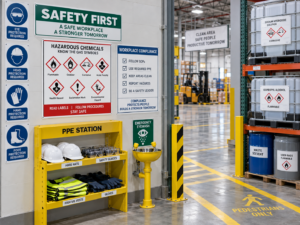
The Legal and Operational Stakes of Hazardous Chemical Labeling
In the chemical manufacturing, processing, and distribution sectors, an unreadable, bleached, or peeling label represents an immediate safety hazard and a severe regulatory violation. Chemical containers move through complex supply chains, transfer depots, and terminal blending tanks where handling personnel depend entirely on container labels to identify acute toxicity, flammability, and environmental hazards.
Relying on standard office desktop inkjet/laser equipment or direct thermal paper introduces critical vulnerabilities:
- Solvent Dissolution and Acid Degradation:Water-based inkjet inks and desktop laser toners break down immediately upon contact with organic solvents like acetone, methyl ethyl ketone (MEK), toluene, xylene, or standard laboratory alcohols. Cellulose paper facestocks absorb liquids, bubble, delaminate, and tear away from curved metal or polyethylene drum walls.
- Direct Thermal Solar and Heat Blackening:Economy direct thermal labels rely on a heat-activated chemical coating. When chemical drums are staged outdoors in open yard storage, exposed to summer sunlight, or transported in hot truck trailers exceeding 45°C, the chemical coating turns entirely dark or pitch black, obliterating warning pictograms, first-aid instructions, and tracking barcodes.
- Maritime Port Quarantines and Regulatory Fines:Under the International Maritime Dangerous Goods (IMDG) code, chemical shipments transported across ocean routes must comply with British Standard BS5609. If container labels fade, peel, or wash away after rough sea exposure, port authorities can quarantine entire freight containers, levy substantial fines against the shipper, and hold chemical manufacturers liable for downstream accidents.
Deploying an industrial-grade GHS label printer completely resolves these operational and legal liabilities. Utilizing controlled thermal transfer energy, the machine melts high-molecular-weight pure resin ribbons into durable synthetic facestocks (such as heavy-gauge polyethylene, polypropylene, or Matte Silver PET). The resulting label forms an indelible chemical bond that withstands solvent spills, continuous saltwater immersion, and multi-year outdoor weathering.
Core Hardware Specifications for Hazardous Container Labeling
Generating durable, legally compliant chemical warning labels requires hardware built to rigorous industrial mechanical and optical standards:
1. Thermal Transfer Printing with Pure Resin Ribbons
Direct thermal printing is legally and physically disqualified for hazardous chemical containers. Your facility requires an industrial thermal transfer label printer capable of driving pure resin ribbons. Pure resin formulations chemically cross-link into synthetic plastic substrates under heat, creating an impermeable graphic barrier impervious to sulfuric acid, caustic alkalis, diesel fuels, hydraulic oils, and high-pressure hot water washes.
2. 300 DPI Ultra-High Resolution Printhead
GHS labels must condense extensive safety data—including multi-lingual first-aid protocols, CAS chemical registry numbers, UN transport codes, supplier contact data, and dense 2D DataMatrix tracking codes—into compact, structured layouts. A 203 DPI printhead produces visible pixelation that causes 4pt to 6pt micro-text to blur and small 2D codes to fail optical verification. A 300 DPI (Dots Per Inch) printhead delivers crisp typography, sharp pictogram lines, and pristine quiet zones, ensuring 100% first-pass read rates with industrial barcode scanners.
3. Precision Optical Sensors for Pre-Printed Red Diamond Alignment
GHS mandates that hazard pictograms feature a prominent red diamond border. Because industrial thermal transfer printers operate in monochrome (using black resin ribbon), chemical facilities purchase synthetic rolls pre-printed with blank red diamond frames. The printer must feature sensitive, adjustable transmissive (gap) and reflective (black mark) optical sensors to calibrate each label’s top-of-form boundary precisely. This ensures black pictograms (flame, skull, corrosion symbols) and text print centered inside the red borders without vertical or horizontal registration drift.
4. Wide-Format Media Handling for Drums and IBC Totes
Chemical packaging spans diverse formats, from 500ml glass laboratory reagent bottles to 5-gallon pails, 55-gallon steel drums, and 1,000-liter Intermediate Bulk Containers (IBC totes). Because GHS label dimensions are legally tied to container capacity (e.g., drums require large formats such as 6×8 inches or 8×11 inches, while intermediate jugs use 3×4 inches), your printing hardware must feature heavy-duty platen rollers, high-torque feed stepper motors, and adjustable media guides to feed narrow 1-inch labels as smoothly as wide-format synthetic sheets.
5. BS5609 Maritime Immersion Compliance Readiness
For international marine transport, chemical drum labels must meet the British Standard BS5609. Section 2 certifies the dimensional stability and adhesive strength of the blank synthetic substrate after three months of ocean saltwater immersion. Section 3 certifies print permanence, testing the specific combination of the thermal transfer printer, the pure resin ribbon, and the label facestock against artificial weathering, intense UV radiation, and abrasive sand slurries. Ensuring your printer can deliver the calibrated heat and printhead downforce required to fuse certified BS5609 media guarantees international compliance.
Technical Comparison: Chemical Container Labeling Technologies
| Performance Metric | Standard Office Printing (Inkjet / Laser) | Direct Thermal Printing (3-Proof Paper) | Industrial GHS Thermal Transfer Printer |
| Imaging Technology | Liquid ink or toner baked on paper | Heat-activated chemical paper coating | Pure resin ribbon melted into synthetic plastic |
| Required Consumables | Ink cartridges / toner + flat sheet paper | Direct thermal paper roll (inkless) | Synthetic label rolls + pure resin ribbon |
| Solvent & Chemical Resistance | Zero (dissolves instantly on solvent contact) | Low (chemical drips cause fading or blackening) | Exceptional (impervious to acetone, xylene, and acids) |
| Outdoor UV & Sunlight Stability | Poor (inks bleach out over several months) | Fails completely (turns pitch black in sunlight) | Archival quality (remains sharp and legible for years) |
| BS5609 Ocean Immersion Viability | Fails entirely (paper disintegrates in water) | Fails entirely (coating softens and delaminates) | Fully compliant (with certified synthetic media) |
| Curved Drum Surface Adhesion | Poor (stiff paper flags off steel curves) | Moderate (standard paper tends to lift) | Superior (heavy-duty synthetic films conform tightly) |
| Primary Industrial Use Case | Safety Data Sheet (SDS) office filing | Temporary indoor carton routing | Drums, IBC totes, reagent bottles, gas cylinders |
Recommended Detonger Models for Hazardous Container Labeling
Detonger leverages 16 years of independent research, global ISO9001 quality certifications, CE standards, and 11 invention patents to deliver reliable thermal hardware suited for heavy industrial compliance and chemical manufacturing.
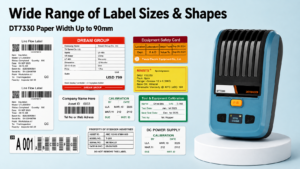
Detonger DT7330: Heavy-Duty Industrial Wide-Format Solution
For chemical manufacturing plants, solvent blending facilities, and hazardous distribution centers tagging 5-gallon pails, 55-gallon bulk drums, and IBC totes, the Detonger DT7330 3-inch Thermal Transfer Printer delivers heavy-duty throughput.
- Why it excels for hazardous containers:The DT7330 accommodates wide synthetic media rolls, offering ample printable area for complex, multi-element GHS layouts with multiple hazard pictograms, multi-column safety statements, and logistics barcodes. Its split-type consumable bay separates the ribbon supply from the label roll, allowing safety managers to load cost-effective bulk rolls of BS5609-grade synthetic substrates and pure resin ribbons. Its precise sensor array keeps black hazard pictograms centered within pre-printed red diamond frames during continuous high-volume production shifts.
Detonger DT6250: Multi-Format Chemical & Pilot Plant Workhorse
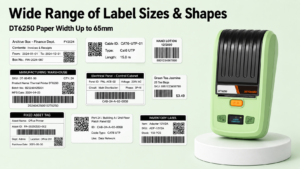
For specialty chemical formulators, pilot plants, and pharmaceutical production suites requiring agile compliance labeling on intermediate jugs, canisters, and bottles, the Detonger DT6250 delivers commercial flexibility.
- Why it excels for hazardous containers:Supporting label widths up to 61mm (2.5 inches) at a sharp 300 DPI resolution, the DT6250 outputs crisp micro-typography, chemical formulas, and dense DataMatrix codes on synthetic PET labels. Its split-architecture design lowers ongoing per-label consumable costs while maintaining high resistance to chemical washdowns and corrosive vapors.
Detonger DT5150: The Compact Laboratory Reagent Specialist
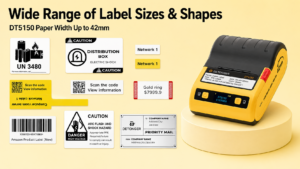
For quality control (QC) labs, analytical testing suites, and chemical sampling teams tagging small reagent vials, flasks, and sampling jars, the Detonger DT5150 1.5-inch All-in-One Thermal Transfer Printer provides benchtop precision.
- Why it excels for hazardous containers:Featuring a 300 DPI printhead, the DT5150 fits small-footprint hazard warnings, signal words, and dynamic QR codes onto compact 15mm to 36mm synthetic labels. Its sealed, all-in-one consumable cassette integrates the pure resin ribbon and synthetic media into a single drop-in cartridge, allowing laboratory technicians to swap label stocks without manual ribbon threading or exposing cleanroom spaces to airborne contaminants.
Automating Chemical Safety Workflows with WePrint Software
An industrial GHS label printer requires intelligent software to eliminate manual transcription errors and guarantee regulatory conformity. Detonger hardware integrates natively with the WePrint application across iOS, Android, and Windows PC.
WePrint simplifies chemical compliance through dedicated workflow features:
- Standardized GHS Template Libraries:Safety managers can build standardized templates featuring locked regulatory frameworks, certified GHS pictograms, and designated fields for signal words, hazard codes (H-statements), and precautionary statements (P-statements).
- Excel & ERP Database Synchronization:Chemical batch data, CAS numbers, and lot-specific hazard profiles can be imported directly from Excel spreadsheets or corporate ERP systems. WePrint automatically maps dynamic chemical data into the template, allowing technicians to batch-print serialized compliance labels without manual re-typing.
- Traceability Barcode & Digital SDS Integration:The software generates high-contrast 1D and 2D barcodes linking directly to digital Safety Data Sheets (SDS), certificates of analysis (COA), or emergency response guidelines, allowing first responders or warehouse workers to scan a container with a smartphone to access critical chemical data instantly.
Selecting the right GHS label printer shields your enterprise against regulatory penalties, prevents catastrophic workplace accidents, and ensures your chemical shipments move through global supply chains without delay. Explore Detonger’s specialized Thermal Transfer Label Printer collection, or discover our high-performance Industrial Label Printer for Manufacturing, Warehouse and Durable Labels solutions to upgrade your hazardous labeling infrastructure today.
Frequently Asked Questions (FAQs)
Q: Can a monochrome thermal transfer GHS printer print labels with red hazard diamonds?
A: Yes. Industrial thermal transfer printers print using a single black resin ribbon. To achieve compliant two-color GHS labels affordably, chemical facilities purchase synthetic label rolls pre-printed with blank red diamond borders from a converter. The GHS label printer’s precision optical sensors calibrate to the pre-printed layout, printing the black hazard symbols (such as the flame, skull, or corrosion icon) and safety text cleanly inside the corresponding red diamonds.
Q: Why is direct thermal printing prohibited for hazardous chemical containers?
A: Direct thermal labels rely on a chemical coating that reacts to heat. Exposure to ambient sunlight, radiant heat from machinery, or accidental contact with cleaning solvents, alcohols, and acids will instantly turn the paper dark or completely erase the print. Because GHS regulations require hazard warnings to remain fully legible throughout the product’s entire lifecycle under harsh industrial conditions, direct thermal paper cannot legally or physically meet compliance standards.
Q: What is the difference between BS5609 Section 2 and Section 3 for chemical drum labels?
A: BS5609 is the British Standard for maritime immersion testing on chemical labels. Section 2 tests the physical label material and adhesive: the blank synthetic substrate must remain stuck to a marine testing plate after three months of ocean saltwater immersion. Section 3 tests the print permanence: it evaluates the specific combination of the thermal transfer printer, the pure resin ribbon, and the label facestock against artificial weathering, saltwater, and abrasive sand slurries to verify that the printed warning text and pictograms remain completely legible.