
A handheld label maker equipped with wireless Bluetooth connectivity is an essential thermal printing tool for retail floor associates, telecom field technicians, warehouse supervisors, and facility maintenance crews. Unlike legacy standalone labelers that require pecking out alphanumeric characters on cramped mechanical ABC or QWERTY keypads, modern Bluetooth-enabled portable label makers delegate the entire layout interface to iOS, Android, and PC devices. This allows operators to leverage multi-touch screen design, instant camera barcode scanning, and direct cloud database integration. However, choosing the right mobile hardware requires evaluating several core technical benchmarks: thermal imaging technology (direct thermal vs. thermal transfer), optical resolution (300 DPI for micro-barcodes and 2D matrices), ergonomic battery capacity, and drop-in media versatility. Field operators must evaluate their physical workflows: if your team loses billable hours to manual typing bottlenecks, connection dropouts in metal-shielded equipment closets, or smeared paper tags, choosing a rugged Bluetooth handheld device is a mandatory operational upgrade.
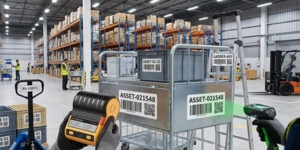
Why Bluetooth Decentralizes Field Labeling Operations
In fast-paced enterprise environments, tethered desktop printers and mechanical standalone label makers create severe productivity bottlenecks:
- The Bottleneck of Mechanical Keypads:Typing long serial numbers, chemical names, or cable routing identifiers on rubber mini-buttons is slow and invites severe typographical errors. A single wrong keystroke ruins the tag and wastes expensive consumables.
- The Inefficiency of Office-Tethered Printing:In large warehouses or commercial buildings, requiring technicians to return to a centralized office computer to print batches of tags forces workers to walk thousands of unproductive steps daily. If a tag is dropped or an extra circuit is discovered, the worker must halt operations and hike back to the terminal.
- Legacy Standalone Limitations:Traditional handheld units lack database connectivity, dynamic QR code calculation, and custom corporate logo rendering. They produce generic, primitive-looking text strips that fail to meet modern enterprise asset tracking and retail branding standards.
A Bluetooth-connected handheld label maker decentralizes tagging entirely. Weighing under 400g and pairing instantly via low-latency Bluetooth Low Energy (BLE), the printer allows technicians to design and execute print jobs on a smartphone or industrial PDA. Workers can scan an existing barcode using their phone’s camera, pull live inventory data from an ERP spreadsheet, and generate a standardized, scannable marker right at the shelf, electrical panel, or server rack.
Key Technical Features to Look For in a Bluetooth Handheld Label Maker
When procuring commercial mobile printing hardware, B2B buyers and field operations managers should evaluate candidate devices across five critical engineering criteria:
1. Thermal Imaging Technology: Direct Thermal vs. Thermal Transfer
The underlying thermal process determines how long your labels survive in the field:
- Direct Thermal (DT):Best for short-turnaround, cost-sensitive indoor tasks like boutique price adjustments, shelf-edge bin labeling, and shipping routing. It uses chemically treated paper that reacts to heat, requiring zero ribbons or ink. However, it will fade or turn dark when exposed to sunlight, friction, or ambient temperatures above 50°C.
- Thermal Transfer (TT):Mandatory for durable infrastructure like telecom wire labeling, fixed IT assets, and outdoor equipment. A thermal transfer label printer uses a heated printhead to melt solid resin into synthetic plastic films (such as Matte Silver PET or flexible polyolefin). This creates an archival mark impervious to water, isopropyl alcohol, oils, and multi-year UV exposure.
2. Optical Resolution: 203 DPI vs. 300 DPI
Standard 203 DPI is sufficient for large retail prices and broad 1D barcodes. However, field technicians marking narrow cables, 1.5ml laboratory cryotubes, or circuit boards require micro-labels measuring 15mm to 25mm. High-density 2D DataMatrix codes, fine 4pt schematics, and compact QR codes demand a 300 DPI (Dots Per Inch) printhead. The finer dot pitch prevents micro-modules from blurring together, ensuring rapid, reliable first-pass scans with optical imagers and smartphones.
3. All-in-One Sealed Consumable Cassettes
In dusty telecom vaults, active manufacturing floors, or cleanrooms, field workers cannot waste time manually threading delicate, flimsy ribbon rolls around exposed internal gears. Look for portable units utilizing all-in-one consumable cartridges that integrate both the synthetic media roll and the pure resin ribbon into a single sealed drop-in unit. This enables one-handed reloading in seconds while protecting the printhead from airborne copper shavings, dust, and moisture.
4. Battery Endurance and Charging Architecture
A mobile tool is useless if it dies mid-shift. Commercial handheld units should feature high-capacity lithium-ion battery packs (ranging from 1200 mAh to 2600 mAh) capable of supporting 4 to 8 hours of continuous batch printing or several days of standby operation. Furthermore, universal USB Type-C charging ensures technicians can recharge devices in service vans, from power banks, or at field workstations without carrying proprietary AC power bricks.
5. Media Versatility (Tubing, Wraps, and Synthetics)
A professional mobile printer must accommodate diverse substrates beyond standard flat paper. Ensure the internal paper path handles continuous synthetic tapes, die-cut adhesive stickers, self-laminating cable wraps, and non-adhesive heat shrink tubing for electrical conductors.
Technical Comparison: Handheld Printing Architectures
| Performance Metric | Traditional Standalone Keypad Unit | Direct Thermal Bluetooth Handheld | Thermal Transfer Bluetooth Handheld |
| User Interface | Tiny physical keyboard & monochrome LCD | Full-color smartphone / tablet multi-touch | Full-color smartphone / tablet multi-touch |
| Data Input Method | Slow manual character-by-character typing | Excel / CSV import, barcode scan, cloud sync | Excel / CSV import, barcode scan, cloud sync |
| Consumable System | Proprietary paper/laminated cartridges | Direct thermal rolls (inkless, low cost) | All-in-one synthetic + resin ribbon cassette |
| Barcode & 2D Capabilities | Basic 1D barcodes, primitive formatting | 1D & dense 2D QR codes (up to 300 DPI) | 1D & dense 2D DataMatrix (up to 300 DPI) |
| Environmental Resilience | Moderate (laminated tape holds light wear) | Low to Moderate (heat & UV sensitive) | Extreme (impervious to water, oil, chemicals) |
| Ideal Field Use Case | Basic office drawers, simple pantry bins | Retail floor pricing, bakery shelf tags | IT asset racks, wire harnesses, lab vials |
Recommended Detonger Models for Mobile Field Labeling
Detonger leverages 16 years of independent research, global ISO9001/CE certifications, and 11 invention patents to deliver rugged thermal hardware engineered for mobile enterprise workflows.
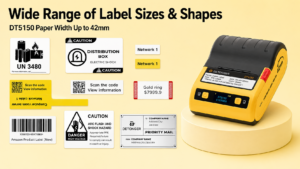
Detonger DT5150: The High-Precision Thermal Transfer Specialist
For IT administrators, telecom installers, field electricians, and biomedical researchers requiring indestructible markings on narrow substrates, the Detonger DT5150 1.5-inch All-in-One Thermal Transfer Printer delivers benchtop precision in a handheld footprint.
- Why it excels in the field:Outputting at an ultra-sharp 300 DPI, the DT5150 renders microscopic 2D DataMatrix codes, wiring schematics, and serial numbers on labels up to 36mm wide. Its sealed drop-in cassette combines the pure resin ribbon and synthetic Silver PET, heat shrink tubing, or self-laminating vinyl into a single cartridge. Technicians can swap materials in seconds with zero manual ribbon threading. Built-in Bluetooth connects instantly to iOS and Android devices, allowing on-the-spot printing inside telecom closets and electrical panels.
Detonger DP27 Series: The Agile Direct Thermal Retail Champion
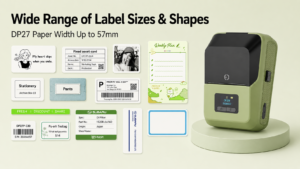
For boutique shopkeepers, supermarket floor staff, dry food packagers, and inventory organizers needing fast, inkless labeling, the Detonger DP27 Series (including the 300 DPI DP27P) offers a lightweight direct thermal solution.
- Why it excels in the field:Weighing just 292g, this ultra-portable 2-inch unit fits comfortably in an apron pocket or on a belt clip. Supporting direct thermal media up to 57mm wide, it is ideal for on-the-spot price adjustments, shelf-edge bin tagging, and promotional sale stickers. Operating without ink or ribbons, it keeps consumable overhead to an absolute minimum while delivering crisp barcodes on demand.
Streamlining Mobile Tagging with WePrint Software
A commercial-grade handheld label maker is only as capable as its software ecosystem. Detonger mobile printers integrate natively with the WePrint application across iOS, Android, and Windows PC.
WePrint eliminates the manual typing bottlenecks associated with outdated mechanical label makers:
- Direct Excel & CSV Spreadsheet Binding:Technicians can import complete asset registers or pricing spreadsheets directly from their mobile device. WePrint automatically maps database columns to custom templates, batch-printing serialized barcode tags or wire markers via Bluetooth in minutes.
- Automated Alphanumeric Counters:Built-in serialization algorithms enable dynamic auto-incrementing lot numbers, cable phases, and timestamps without manual data entry.
- Barcode & QR Code Symbology Engine:Generates verified 1D retail codes (UPC/EAN, Code 128) and dense 2D QR codes linking directly to online service portals, digital wiring schematics, or equipment manuals.
Selecting the right portable label printer and handheld label maker for small business comes down to matching the imaging mechanism and connectivity to your operational demands. Explore Detonger’s specialized Thermal Label Printer collection, or discover our high-durability Industrial Label Printer for Manufacturing, Warehouse and Durable Labels lineup to equip your mobile workforce with professional-grade marking tools today.
Frequently Asked Questions (FAQs)
Q: Why is a Bluetooth handheld label maker better than one with a built-in keyboard?
A: Label makers with built-in physical keyboards rely on small rubber buttons and low-resolution monochrome LCD screens, making data entry slow and prone to typographical errors. A Bluetooth handheld label maker connects to your smartphone or tablet, giving you a full-color touchscreen interface, dynamic graphics editing, camera-based barcode scanning, and the ability to import entire Excel spreadsheets for batch printing without manually typing a single character.
Q: Can I use a Bluetooth handheld label maker without an active internet connection?
A: Yes. Bluetooth communication operates locally between your mobile phone or tablet and the printer. Once the companion software (such as Detonger’s WePrint app) is installed and your templates or spreadsheets are saved on your device, you can design and print labels in basements, metal electrical vaults, or remote outdoor job sites with zero internet access or cellular signal.
Q: How do I know if I need a direct thermal or thermal transfer Bluetooth handheld printer?
A: Choose direct thermal if you need a lightweight, low-cost, inkless tool for short-term indoor uses like retail shelf pricing, bakery labels, or temporary file organization. Choose thermal transfer if your labels must endure harsh conditions—such as IT server heat, outdoor sunlight, chemical solvent wipe-downs, or cable labeling—because thermal transfer melts resin ribbon into synthetic films for permanent, archival-grade durability.