
A handheld label maker is a compact, battery-powered thermal printing device engineered for retail personnel, field service technicians, laboratory researchers, and warehouse staff to generate scannable identification tags on the spot. When selecting a handheld unit, the primary architectural decision comes down to the underlying thermal imaging method: direct thermal (DP) or thermal transfer (DT). Direct thermal models use chemically treated paper that darkens when heated, providing a fast, inkless, and cost-effective approach for short-turnaround indoor tagging. Conversely, thermal transfer units melt a solid ink ribbon directly into synthetic facestocks, creating archival-grade markers impervious to moisture, friction, industrial chemicals, and UV exposure. Business buyers must evaluate their operational environment: if your tags face outdoor sunlight, heat inside server racks, or chemical sterilization, investing in a portable thermal transfer unit is mandatory to prevent label failure and inventory misidentification.
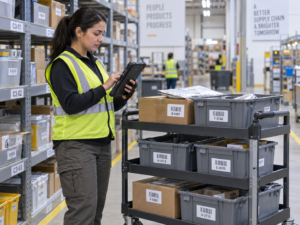
Understanding the Operational Stakes: Direct Thermal vs. Thermal Transfer
In dynamic field environments, choosing the wrong print technology introduces significant operational friction.
A direct thermal handheld label maker relies on a heated printhead that activates microscopic leuco dyes within specially treated thermal paper. Because this process requires no ink cartridges, toners, or thermal ribbons, operating overhead remains exceptionally low. However, the chemical surface remains permanently heat-reactive. If a direct thermal label is exposed to direct sunlight on a loading dock, high temperatures inside a telecom cabinet, or accidental friction from automated sortation belts, the entire background darkens or turns pitch black, instantly rendering 1D barcodes, 2D QR codes, and text completely illegible.
A thermal transfer handheld label maker solves these vulnerability issues by introducing a thermal ribbon. The printhead elements apply concentrated heat to melt pigmented wax, wax-resin, or pure resin polymers directly into the surface pores of synthetic films (such as Matte Silver PET, polypropylene, or cross-linked polyolefin tubing). Because the resulting graphic is composed of an inert polymer rather than a heat-sensitive chemical layer, the printed image will not fade, darken, or degrade when subjected to extreme temperatures, organic solvents, or years of physical handling.
Technical Comparison: Evaluating Handheld Thermal Technologies
To achieve the best return on investment, decision-makers must align thermal imaging capabilities with their specific durability and budgetary constraints:
| Evaluation Metric | Direct Thermal Handheld Units | Thermal Transfer Handheld Units |
| Imaging Mechanism | Heat activates chemical dye in label paper | Heated printhead melts solid ribbon onto synthetic media |
| Consumable Configuration | Single consumable (thermal paper roll only) | Dual consumable (synthetic label roll + ribbon, or all-in-one cassette) |
| Sunlight & UV Stability | Poor (fades or turns black within weeks outdoors) | Archival quality (remains sharp for 5 to 10+ years) |
| Chemical & Solvent Resistance | Zero (rubbing alcohol, oils, and acetone erase text) | Extreme (pure resin resists alcohol, fuels, and solvents) |
| Heat & Abrasion Resistance | Low (friction scuffs paper; turns black above 50°C) | High (withstands heat guns, engine bays, and abrasion) |
| Printhead Lifespan | Moderate (direct contact with chemical paper) | Extended (smooth polyester ribbon backing protects printhead) |
| Optimal Business Applications | Retail price tags, short-cycle bin tags, bakery labels | IT asset tracking, cable marking, laboratory cryovials, GHS |
Critical Hardware Features to Prioritize in Mobile Units
Regardless of whether you deploy direct thermal or thermal transfer technology, selecting commercial-grade handheld hardware requires evaluating specific physical and mechanical factors:
- Printhead Resolution (203 DPI vs. 300 DPI):While 203 DPI suffices for large retail pricing and standard 1D barcodes, compact enterprise tagging demands a 300 DPI printhead. High-density 2D DataMatrix codes on IT server tags or 1.5ml laboratory cryotubes require 300 DPI to prevent microscopic dot bleed, guaranteeing 100% first-pass read rates under optical scanners.
- Sealed Drop-In Cassettes vs. Open Rolls:In cleanrooms, outdoor construction zones, or telecom vaults, field technicians cannot waste billable time manually threading delicate ribbon rolls around open spools. Look for thermal transfer units utilizing sealed, all-in-one consumable cassettes that integrate both the resin ribbon and synthetic media into a single drop-in cartridge.
- Ergonomics and Battery Endurance:Commercial field operations require devices weighing under 400 grams to prevent operator fatigue during extended multi-hour tagging runs. High-capacity lithium-ion batteries (ranging from 1200 mAh to 2600 mAh) paired with intelligent sleep modes ensure the printer sustains full-shift batch printing without midday recharging.
- Media Versatility:Ensure the internal feed path accommodates diverse substrates—ranging from standard continuous rolls and die-cut adhesive stickers to specialized non-adhesive heat shrink tubing, wrap-around self-laminating vinyl, and thick plastic tags.
Recommended Detonger Handheld Hardware
Detonger leverages 16 years of independent research, global ISO9001/CE certifications, and 11 invention patents to deliver purpose-built mobile printing hardware tailored for enterprise workflows.
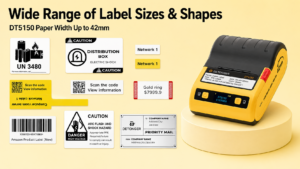
Detonger DT5150: The High-Precision Thermal Transfer Specialist
For IT infrastructure, telecom technicians, clinical laboratories, and industrial asset tracking where extreme durability on narrow media is mandatory, the Detonger DT5150 1.5-inch All-in-One Thermal Transfer Printer provides superior performance.
- Why it excels:Equipped with a precision 300 DPI printhead, the DT5150 renders microscopic 2D DataMatrix codes, complex wiring diagrams, and fine typography down to 4pt on labels up to 36mm wide. Its sealed, all-in-one consumable cassette loads both pure resin ribbon and synthetic Silver PET or heat shrink tubing in a single step, preventing printhead contamination in dusty field environments. Powered by Bluetooth, field workers can generate permanent, chemical-resistant markers directly at the server rack or job site.
Detonger DP27 Series: The Agile Direct Thermal Champion
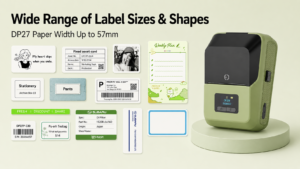
For boutique retail shops, supermarket floor staff, dry food packagers, and office organizers needing fast, inkless labeling, the Detonger DP27 Series (including the 300 DPI DP27P) offers a lightweight direct thermal solution.
- Why it excels:Weighing just 292g, this ultra-portable 2-inch unit fits comfortably in an apron pocket. It supports direct thermal media up to 57mm wide, making it ideal for on-the-spot price adjustments, inventory shelf-edge tags, and promotional stickers. Operating without ink or ribbons, it keeps consumable overhead to an absolute minimum while delivering crisp barcodes on demand.
Streamlining Mobile Tagging with WePrint Software
A commercial handheld label maker requires intuitive software to eliminate transcription errors. Detonger mobile printers integrate natively with the proprietary WePrint application across iOS, Android, and Windows PC.
WePrint eliminates the manual typing bottlenecks associated with outdated mechanical label makers. Technicians can import complete asset registers or pricing spreadsheets directly from Excel (.xlsx) or CSV files. The software maps database columns to custom templates, allowing staff to batch-print serialized barcode tags or wire markers via Bluetooth in minutes. Furthermore, built-in serialization algorithms enable dynamic auto-incrementing lot numbers, cable phases, and timestamps without manual data entry.
Selecting the right portable label printer and handheld label maker for small business comes down to matching the imaging mechanism to your environmental demands. Explore Detonger’s specialized Thermal Label Printer collection and high-durability Thermal Transfer Label Printer lineup to equip your team with the optimal mobile labeling technology today.
Frequently Asked Questions (FAQs)
Q: Can I use direct thermal labels for electrical panel or wire labeling?
A: It is strongly advised against. Electrical switchboards, server cabinets, and motor housings generate significant internal heat. Direct thermal labels react to heat and will turn completely black over time, obliterating wire numbers and phase IDs. Wire marking and electrical labeling should always be executed with a thermal transfer printer utilizing synthetic vinyl wraps, polyolefin heat shrink tubing, and pure resin ribbons.
Q: Do thermal transfer handheld label makers require messy liquid ink cartridges?
A: No. Thermal transfer technology does not use liquid ink or toner. It uses a dry, solid polymer ribbon (wax, resin, or a hybrid blend) coated onto an ultra-thin polyester backing film. When the heated printhead elements press the ribbon against the label, the solid ink melts and fuses into the material instantly. There is zero liquid to smear, leak, or dry out.
Q: Which printing technology has lower long-term operating costs?
A: Direct thermal has a lower upfront consumable cost because it requires only one consumable (the heat-sensitive paper roll) and no ribbons. It is the most economical choice for short-term indoor uses like retail shelf pricing and temporary shipping tags. However, if a label must survive multiple years outdoors, in freezers, or under chemical exposure, thermal transfer is far more cost-effective in the long run because it prevents expensive relabeling, unreadable inventory losses, and regulatory compliance fines.