
A heat shrink label printer is a specialized industrial thermal printing system engineered to print permanent alphanumeric legends, wire numbers, and machine-readable barcodes directly onto continuous, flattened polyolefin tubing. Unlike standard office labelers or consumer sticker makers that feed flat adhesive paper over silicone backing, a heat shrink tube printer operates on a continuous, non-adhesive, hollow cross-linked polymer sleeve. The fundamental mechanical and thermal principle behind the technology involves three interconnected stages: high-torque mechanical feeding of thick flattened tube stock, high-temperature thermal transfer fusing using pure resin ribbon, and post-print thermal recovery via an industrial heat gun. For control panel builders, aerospace harness technicians, and electrical contractors, understanding how a heat shrink printer works is essential for choosing the right machine, avoiding ribbon wrinkling, and ensuring indelible, code-compliant wire identification that survives 600V electrical demands and harsh operating conditions.

The Three Core Stages of Heat Shrink Tube Printing
Understanding the operational physics of a heat shrink label printer requires looking at how raw cross-linked polyolefin tubing transforms into an insulated, permanent wire marker:
Stage 1: High-Torque Mechanical Feed & Guide Alignment
Heat shrink tubing is supplied in a continuous, flattened roll. Unlike thin paper labels that measure less than 0.1mm thick, flattened polyolefin tubing is substantially thicker (often 0.4mm to 0.8mm for both walls combined), rigid, and elastic.
- Drive Mechanics:The printer employs high-torque stepper motors paired with high-traction, vulcanized rubber platen rollers to grip the tubing without slipping.
- Media Guidance:Precision internal media baffles keep the tube centered directly over the platen roller. Because the tubing lacks an adhesive liner, precise lateral guidance is critical to prevent walking, diagonal skew, and feeding jams across long continuous batch runs.
Stage 2: Thermal Transfer Solid-Resin Fusing
Direct thermal printing cannot be used for heat shrink tubing because direct thermal paper uses heat-reactive chemicals that would turn pitch black under a heat gun. Instead, a dedicated heat shrink tube printer relies strictly on the thermal transfer process:
- The Printhead:An array of microscopic resistive heating elements (operating at 300 DPI, or roughly 11.8 dots/mm) pulses electrical energy to generate localized, controlled heat spikes.
- The Thermal Ribbon:A specialized pure resin ribbon travels between the printhead and the flattened tubing. The solid resin formulation consists of cross-linking polymer binders and carbon black or color pigments coated on an ultra-thin polyester (PET) carrier film.
- Molecular Interlock:Under combined heat (often 70°C to 110°C) and calibrated mechanical pressure, the solid resin melts and penetrates the porous, treated surface layer of the polyolefin tubing. As it cools milliseconds later, it re-solidifies, forming an indelible mechanical and chemical bond resistant to abrasion and chemicals.
Stage 3: Heat Recovery & Proportional Shrinking
After the printer feeds and cuts the printed sleeve to length, the technician slides the hollow tube over a bare conductor or crimped terminal lug.
- Polymer Memory:Polyolefin tubing is cross-linked using high-energy electron beams during manufacturing, giving the material “elastic memory.”
- Heat Gun Activation:When exposed to a heat source (typically an industrial heat gun operating between 120°C and 250°C), the expanded crystalline structures within the polymer relax, causing the sleeve to shrink down to 50% (2:1 shrink ratio) or 33% (3:1 shrink ratio) of its supplied diameter.
- Legend Integrity:Because the pure resin ribbon was fused directly into the polyolefin substrate, the printed legend contracts proportionally with the tubing. The text and barcodes do not flake, crack, smudge, or stretch out of alignment.
Technical Specifications: What Makes a Heat Shrink Printer Unique?
A purpose-built heat shrink label printer differs from generic desktop thermal transfer hardware across several key engineering benchmarks:
| Engineering Dimension | Standard Thermal Transfer Printer | Dedicated Heat Shrink Label Printer |
| Media Thickness Handling | Up to 0.15 mm – 0.20 mm | Up to 0.60 mm – 0.90 mm (flattened tube walls) |
| Feed Roller Traction | Standard silicone or light rubber | High-durometer vulcanized anti-slip rubber |
| Printhead Clearance & Pressure | Low mechanical clearance for flat paper | Extended mechanical stroke with reinforced spring tension |
| Ribbon Compatibility | Wax, Wax-Resin, or Resin | Pure high-temperature resin only |
| Cutter Mechanism | Rotary light-duty sheet cutter | Heavy-duty guillotine or shear cutter for tough polyolefin |
| Primary Media Form Factor | Adhesive-backed die-cut rolls on paper liner | Continuous non-adhesive flattened tubing rolls or cassettes |
Common Printing Issues & How Machine Mechanics Solve Them
Printing onto non-adhesive, heavy-gauge plastic sleeves introduces operational challenges that substandard hardware cannot overcome:
- Ribbon Wrinkling (Diagonal Voids):Because flattened tubing is thick, uneven pressure across the printhead can cause the ultra-thin resin ribbon to buckle and wrinkle as it passes over the platen roller. Professional heat shrink printers incorporate independent, dual-torsion pressure adjustment toggles that allow technicians to balance printhead downforce across the width of the tube.
- Static-Induced Media Drift:Polyolefin is a strong electrical insulator. Fast mechanical feeding generates static charges that attract dust and cause the sleeve to cling to metal guides. Commercial machines integrate grounded conductive brushes and static dissipation tracks to keep media traveling in a straight line.
- Cutter Jams on Heavy Tubing:Cutting through two layers of cross-linked polyolefin dulls weak scissors and jams rotary blades. High-grade wire marking printers utilize hardened tool-steel guillotine cutters capable of completing thousands of clean full-cuts and partial perforations (half-cuts) without snagging.
Recommended Detonger Models for Heat Shrink Tube Printing
Detonger leverages 16 years of independent research, global ISO9001/CE certifications, and 11 invention patents to deliver reliable thermal hardware tailored for electrical infrastructure and wire harness manufacturing.
Detonger DT5150: The Portable Panel Builder’s Toolbelt Specialist
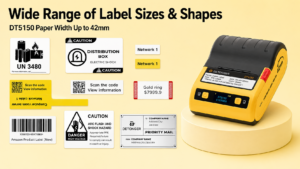
For industrial electricians, telecom technicians, and control panel wiremen working on site, the Detonger DT5150 1.5-inch All-in-One Thermal Transfer Printer delivers compact, field-ready precision.
- Why it excels for heat shrink:Featuring a 300 DPI high-resolution printhead, the DT5150 renders razor-sharp wire IDs, electrical schematics, and micro-barcodes on flattened polyolefin heat shrink tubing up to 36mm wide. Its sealed, all-in-one consumable cassette houses both the resin ribbon and tubing roll inside a single cartridge, allowing technicians to swap between heat shrink sleeves and self-laminating cable wraps in seconds. Powered by long-life battery technology and Bluetooth connectivity, electricians can print serialized wire markers directly inside the control cabinet.
Detonger DT5250: Heavy-Duty Industrial Harness Workhorse
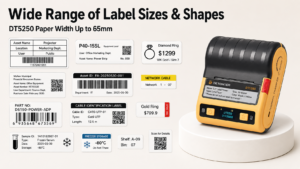
For switchgear manufacturing facilities, automation machine builders, and power substation contractors handling heavier gauge conductors and high daily volume, the Detonger DT5250 provides expanded capacity.
- Why it excels for heat shrink:Supporting media widths up to 63mm (2.5 inches) at 300 DPI, the DT5250 easily feeds heavy-gauge 3:1 and 2:1 shrink ratio tubing for thick multi-conductor industrial power cables and battery feeds. Its high-torque drive mechanism feeds thick continuous tubing without feeding slippage, while its robust internal architecture easily sustains 10-hour installation shifts.
Automating Wire Schedules with WePrint Software
A high-performance heat shrink label printer requires intelligent design and database software to eliminate manual typing bottlenecks and miswiring errors. Detonger hardware integrates natively with the WePrint application across iOS, Android, and Windows PC.
WePrint streamlines electrical labeling workflows through dedicated features:
- Rule-Based Serialization:Technicians can configure dynamic sequential wire numbering rules (such as TB1-001 through TB1-500) with customized step values, leading zeros, and phase prefixes.
- Excel Wire Schedule Import:For enterprise panel projects, engineers can import complete wire run lists directly from Excel spreadsheets. WePrint automatically maps conductor source, destination, and wire ID columns into pre-calibrated heat shrink templates.
- Adjustable Sleeve Length & Cut Indicators:The software allows operators to calibrate individual sleeve lengths to fit terminal spacing perfectly, minimizing tube waste during high-volume assembly runs.
Investing in a dedicated heat shrink label printer protects your electrical infrastructure against short circuits, simplifies troubleshooting, and ensures complete compliance with electrical inspection standards. Explore Detonger’s specialized Cable Label Printer for Wire, Electrical and Heat Shrink Labels collection, or discover our comprehensive Durable Wire & Cable Label Printing Solutions to equip your team with professional-grade marking tools today.
Frequently Asked Questions (FAQs)
Q: Can a standard desktop label printer print on heat shrink tubing?
A: Generally, no. Standard label printers are designed for thin, flat paper or film with a silicone backing liner (under 0.2mm total thickness). Flattened heat shrink tubing is significantly thicker, stiffer, and exerts heavy drag against standard feed rollers. A dedicated heat shrink printer features heavy-duty drive motors, wider mechanical clearances, reinforced platen rollers, and specialized cutting blades designed specifically for polyolefin.
Q: Why does the printed text on heat shrink tubing not smudge or peel when heated?
A: Heat shrink printing uses thermal transfer technology with pure resin ribbon. The printer’s thermal printhead melts solid resin polymers directly into the surface layer of the polyolefin tubing. When heated with an industrial heat gun, the polyolefin tube contracts while the embedded resin flexes and shrinks proportionally with the substrate, forming an indelible bond that resists flaking, smudging, or cracking.
Q: What is the difference between full-cut and half-cut (perforation) modes on tube printers?
A: Full-cut completely slices through the heat shrink sleeve, dropping individual loose markers. Half-cut (perforation) slices through the printed polyolefin tube while leaving a tiny connecting tab, or cuts through the tubing without separating the roll entirely. Half-cut allows an electrician to print a batch of 50 wire markers in sequential order as a continuous strip, keeping wire schedules organized on the toolbelt until ready for installation.