
A lab tube label printer configured for sequential sample IDs is a precision thermal device engineered for clinical diagnostics, biobanks, genomic sequencing centers, and pharmaceutical laboratories to assign unique, ascending identifiers to biological specimens on demand. Unlike static printing where identical text is mass-produced, sequential sample identification requires dynamic alphanumeric incrementation across micro-vials without interrupting laboratory workflows. The most critical hardware selection criteria include a 300 DPI high-resolution printhead (to render microscopic 2D DataMatrix codes and serialized strings legibly on narrow tubes), thermal transfer printing technology (to endure cryogenic storage down to -196°C and harsh chemical washdowns), and robust LIMS/software database integration. Laboratory supervisors should evaluate their protocol requirements: if your facility processes high-throughput aliquots destined for liquid nitrogen dewars, -80°C freezers, or automated optical analyzers, deploying a dedicated thermal transfer printer is essential to prevent duplicate IDs, misplaced aliquots, and catastrophic data loss.
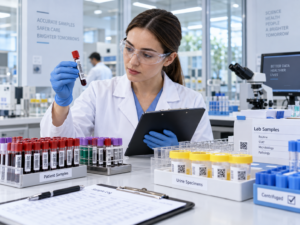
The Operational Risk of Inadequate Sample ID Sequencing
In clinical testing and biospecimen archiving, every aliquot represents a critical link in the chain of custody. When tracking hundreds of microcentrifuge tubes, cryovials, or PCR tubes, any ambiguity in sequential identification creates severe diagnostic and research liabilities.
Legacy labeling practices introduce widespread failure points:
- Handwritten Tubes:Writing sequential numbers with permanent marker pens is slow and prone to illegibility. Ink dissolves immediately when wiped with ethanol or isopropyl alcohol, and human error frequently leads to skipped digits or duplicate IDs.
- Centralized Laser Sheet Printing:Batch-printing sequential numbers on standard office laser sheets in an administrative office forces technicians to transport sheets into cleanrooms. If a sample volume changes or a label tears, the entire sequential run is disrupted, leaving gaps in physical inventory.
- Direct Thermal Fading:Basic direct thermal labels utilize a heat-sensitive chemical coating. In laboratory settings, direct thermal labels turn completely black during autoclave cycles (+121°C) and fade into illegibility when stored in cryogenic freezers, destroying critical serial numbers.
Deploying an industrial-grade lab tube label printer directly at the biosafety bench or accessioning station solves these vulnerabilities. By utilizing thermal transfer energy to melt solid pure resin into cryogenic synthetic polymers, the printer generates dynamic, ascending serial codes in real time. Each specimen receives a permanent, machine-readable identity that withstands sub-zero freezing, boiling water baths, and centrifugal stress.
Critical Technical Specifications for Sequential Tube Marking
Printing sequential sample IDs on micro-tubes requires hardware built around specialized clinical and mechanical parameters:
- 300 DPI High-Resolution Output:Specimen containers such as 0.5ml, 1.5ml, and 2.0ml microcentrifuge tubes offer minimal surface area (often under 12mm x 25mm). Sequential identifiers require displaying human-readable alphanumeric strings (e.g., BIO-2026-0001 through BIO-2026-9999) alongside corresponding 2D DataMatrix or QR codes. A 300 DPI printhead prevents microscopic dots from bleeding together, ensuring barcodes scan instantly under automated plate readers and handheld imagers.
- Thermal Transfer Print Architecture:Survival in chemical and thermal extremes requires a thermal transfer label printer running pure resin ribbon. The resin permanently fuses into synthetic facestocks, creating an indelible marker that actively repels xylene, DMSO, ethanol, and acetone during histology and diagnostic processing.
- Cryogenic & Curved-Surface Substrates:Vials submerged in -196°C liquid nitrogen undergo extreme thermal contraction. Standard paper labels crack and peel. A reliable laboratory printer must feed flexible cryogenic polypropylene or thin Matte Silver PET labels coated with high-tack acrylic adhesives that bend around tight 5mm vial curvatures without “edge lift.”
- Zero-Drift Sensor Calibration:Sequential batch jobs cannot afford label creep. The printer requires sensitive transmissive (gap) and reflective (black mark) optical sensors to calibrate each label boundary precisely, ensuring text and barcodes stay centered across hundreds of consecutive tubes.
Comparison: Direct Thermal vs. Thermal Transfer for Sequential Sample IDs
| Evaluation Parameter | Direct Thermal Printing | Thermal Transfer Printing (Resin Ribbon) |
| Imaging Technology | Heat-activated chemical paper coating | Solid pure resin melted into synthetic plastic |
| Sequential Code Sharpness | Moderate (thermal bleed on small 2D codes) | Exceptional (sharp, high-contrast matrix cells) |
| Solvent Tolerance (Ethanol, Xylene) | Zero (immediate blackening or total erasure) | Extreme (impervious to solvent wipe-downs) |
| Cryogenic & Autoclave Stability | Fails (turns black in heat, fades in cryo) | Archival quality (stable from -196°C to +121°C) |
| Adhesive Grip on Small Tubes | Poor (stiff paper lifts off curved glass/plastic) | Superior (flexible cryo-films hug tube walls tightly) |
| Recommended Clinical Use | Temporary outpatient receipts, general routing | Cryovials, microcentrifuge tubes, PCR plates |
Recommended Detonger Models for Laboratory Sample Sequencing
Detonger leverages 16 years of independent hardware research, global ISO9001/CE certifications, and 11 invention patents to deliver reliable specimen labeling equipment tailored for healthcare and life sciences.
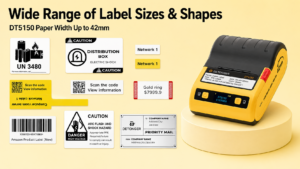
Detonger DT5150: The Micro-Vial & Cleanroom Specialist
For molecular biology suites, genetic testing facilities, and biobanks processing 0.5ml to 2.0ml cryovials, the Detonger DT5150 1.5-inch All-in-One Thermal Transfer Printer delivers compact, benchtop precision.
- Why it excels for sequential tube IDs:Outputting at a crisp 300 DPI, the DT5150 easily prints microscopic 2D DataMatrix codes and sequential text on narrow labels down to 15mm. Its sealed, all-in-one consumable cassette integrates the resin ribbon and synthetic cryogenic label roll into a single cartridge, allowing lab personnel to replace media in seconds without manual ribbon threading or cleanroom particle contamination. Integrated Bluetooth connectivity allows technicians to generate sequential batches directly inside biosafety cabinets.
Detonger DT6250: Multi-Format Laboratory Workhorse
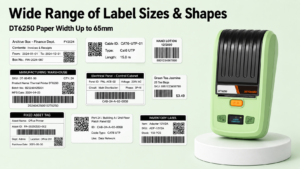
For high-throughput diagnostic centers, hospital pathology departments, and bio-repositories managing mixed containers—including blood collection tubes, reagent bottles, and histology cassettes—the Detonger DT6250 provides expanded media flexibility.
- Why it excels for sequential tube IDs:Supporting label widths up to 61mm (2.5 inches) at 300 DPI, the DT6250 accommodates multi-field formats. Technicians can output a label featuring an ascending human-readable accession number, a linear barcode for legacy racks, and a high-density 2D matrix on a single durable synthetic tag. Its split-architecture media bay accommodates high-capacity continuous rolls, lowering per-label costs during large-scale sequential testing runs.
Automating Sequential Data with WePrint Software
A precision lab tube label printer requires intelligent software to eliminate manual entry errors. Detonger hardware integrates natively with the WePrint application across iOS, Android, and Windows PC.
WePrint simplifies laboratory serialization workflows:
- Rule-Based Incremental Sequencing:Supervisors can configure automated incrementing rules (e.g., setting a start number 0001, defining step increments, applying leading zeros, and appending prefixes like SPEC-A-). Both the alphanumeric text and the 2D matrix advance synchronously on every label.
- Excel & LIMS Database Integration:Technicians can import daily accession manifests directly from Excel (.xlsx) or CSV spreadsheets. WePrint automatically maps sample IDs, draw times, and protocol codes into pre-calibrated tube templates, batch-printing complete sequential series in minutes.
- Enterprise SDK Integration:For automated diagnostic analyzers and central laboratory networks, Detonger provides multi-platform SDKs, allowing IT teams to trigger sequential tube printing directly from internal LIMS or EHR platforms.
Deploying a purpose-built lab tube label printer eliminates handwriting ambiguities, protects cryogenic biological assets against sample loss, and ensures strict compliance throughout testing lifecycles. Explore Detonger’s specialized Medical & Lab Label Printing Solutions and advanced Thermal Transfer Label Printer collection to upgrade your specimen tracking infrastructure today.
Frequently Asked Questions (FAQs)
Q: Can a lab tube label printer print both a sequential human-readable number and a matching sequential QR code?
A: Yes. Advanced software like Detonger’s WePrint allows you to link multiple template elements to a single dynamic counter or database column. As the serial number increments (e.g., from SAM-001 to SAM-002), both the human-readable text string and the corresponding 2D QR code or DataMatrix symbol advance synchronously on each printed label.
Q: Why do sequential labels peel off small 1.5ml tubes in cryogenic storage?
A: Edge lift occurs on small tubes because standard label facestocks (such as paper or rigid polyester) possess too much structural memory to stay bent around a tight 5mm to 10mm radius. When plunged into -80°C or -196°C temperatures, differential thermal contraction causes standard adhesives to crystallize and pop off. To prevent this, use ultra-flexible cryogenic polypropylene labels paired with a specialized low-temperature acrylic adhesive.
Q: What print resolution is required to print sequential 2D barcodes on micro-tubes?
A: A 300 DPI (Dots Per Inch) printhead is strictly required. Micro-tubes require 2D DataMatrix or QR codes as small as 8mm x 8mm. A standard 203 DPI printer produces larger individual dots (0.125mm), which causes the microscopic square cells to bleed together when encoding dynamic, multi-character alphanumeric sequences. A 300 DPI printhead delivers smaller, sharper dots (0.084mm) that maintain crisp cell boundaries and ensure immediate scanner recognition.