
A plant label printer engineered for commercial growers is an industrial thermal printing system built for wholesale nurseries, commercial greenhouse complexes, and timber producers to generate weather-resilient, scannable botanical tags at scale. Unlike retail garden centers that print small retail price stickers, commercial horticulture operations manage hundreds of thousands of specimens across outdoor holding yards, propagation bays, and distribution lanes. The most critical hardware selection criteria for commercial cultivators include printing technology (thermal transfer is mandatory for multi-season UV, fertilizer, and weather resistance), media handling versatility (the ability to feed continuous non-adhesive tree wrap tags, heavy plastic stake tags, and pot collar slips), and industrial-grade throughput with mobile integration. Operations directors must evaluate their environment: if your crops are exposed to intense overhead irrigation, chemical fungicides, and direct sunlight for months, an industrial thermal transfer printer loaded with pure resin ribbon is mandatory to maintain specimen traceability and prevent compliance failures.

The Operational Risk of Inadequate Horticultural Tagging
In large-scale commercial horticulture, an illegible or missing botanical tag represents an immediate financial loss. Specimen varieties, rootstock classifications, patented cultivar rights, and plant health passport numbers must follow every flat, shrub, and bare-root tree from propagation to wholesale distribution.
Relying on standard office desktop printers or manual handwriting creates severe production bottlenecks. Water-based inks wash off under commercial misting systems within minutes, while hand-marker pens fade to illegibility after three weeks of summer UV exposure. Furthermore, attempting to use direct thermal labels (the technology common in retail shipping) leads to crop failure: ambient solar heat and ultraviolet radiation trigger the chemical coating on direct thermal paper, turning the entire tag solid black and permanently destroying plant names and barcodes.
Deploying a commercial plant label printer decentralizes tagging and ensures long-term traceability. By applying high-temperature thermal transfer elements to melt solid resin into durable synthetic polymers (such as heavy-gauge PVC, HDPE, or vinyl), commercial operations generate permanent botanical markers. Whether seedlings sit in a high-humidity misting chamber or broadleaf trees weather a two-year outdoor growing cycle, cultivar names, scannable SKU barcodes, and care protocols remain 100% legible.
Core Hardware Specifications for Commercial Growers
Processing horticultural tags at industrial production volumes requires hardware built around specific mechanical tolerances:
- Thermal Transfer Print Architecture (UV & Chemical Resistance):Direct thermal paper cannot survive outdoor cultivation. Commercial operations require a thermal transfer label printer running pure resin or durable wax-resin ribbons. Resin chemically fuses into synthetic plastic media, creating an impenetrable barrier against overhead irrigation, soil microbes, liquid fertilizers, and prolonged solar radiation.
- Heavy-Gauge Agricultural Media Handling:Commercial plant identification rarely relies on standard adhesive stickers. Printers must handle thick non-adhesive tree wrap-around tags (loop locks), heavy-duty plastic pot stakes, and hanging tags. This demands robust platen rollers, high-torque feed stepping motors, and adjustable media guides that securely center continuous synthetic rolls without feeding skew or jamming.
- Accurate Optical Registration Sensors:Horticultural tags typically feature pre-notched gaps, continuous hole punches, or black-mark indicators along the liner edge. Commercial machines must integrate adjustable reflective (black mark) and transmissive (gap) sensors to calibrate the exact cut and tear boundaries of thick nursery tags at high printing speeds.
- 300 DPI High-Resolution Output:Modern plant passports and wholesale distribution require extensive data within tight footprints. Labels must display botanical Latin taxonomy, common cultivar names, patent disclosures, and 2D QR codes linking wholesale buyers to automated care schedules or inventory manifests. A 300 DPI printhead ensures micro-text and dense 2D matrices remain razor-sharp for optical scanners and smartphone cameras.
Direct Thermal vs. Thermal Transfer for Commercial Nurseries
| Performance Metric | Direct Thermal Printing | Thermal Transfer Printing (Resin Ribbon) |
| Print Mechanism | Printhead heats chemical-coated paper | Printhead melts solid resin into synthetic plastic |
| Required Consumables | Direct thermal paper roll only (no ribbon) | Synthetic plastic tags (PVC/HDPE) + pure resin ribbon |
| UV & Direct Sunlight Resilience | Fails completely (turns solid black under solar heat) | Exceptional (retains crisp contrast over multiple seasons) |
| Moisture & Overhead Irrigation | Poor (paper softens, delaminates, and smears) | Impervious (survives daily soaking, misting, and frost) |
| Fertilizer & Chemical Resistance | Zero (fertilizers and pesticides bleach or blacken tags) | Extreme (withstands sprays, dirt abrasion, and handling) |
| Media Formats Supported | Thin adhesive paper labels | Thick plastic stakes, loop-lock tree wraps, hanging tags |
| Primary Horticultural Use | Short-term shipping labels on dry corrugated boxes | Permanent field stakes, bare-root tree wraps, shrub tags |
Top Detonger Models for Commercial Horticultural Operations
Detonger leverages 16 years of independent research, global ISO9001/CE certifications, and 11 invention patents to deliver robust thermal hardware engineered for agriculture, manufacturing, and heavy-duty field marking.
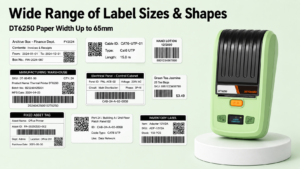
Detonger DT6250: The High-Capacity Nursery Workhorse
For wholesale growers managing outdoor shrub fields, propagation benches, and potted nursery stock, the Detonger DT6250 2.5-inch Thermal Transfer Printer provides industrial-grade media flexibility.
- Why it excels for commercial growers:The DT6250 features a wide media path accommodating substrates up to 61mm (2.5 inches) at a crisp 300 DPI resolution. Its heavy-duty split-type consumable bay separates the ribbon supply from the tag roll, enabling managers to load high-capacity continuous rolls of heavy-gauge PVC stakes and flexible loop-lock tags. The split architecture drives down ongoing consumable overhead during spring potting operations, while its rugged build handles potting shed dust and humidity.
Detonger DT5150: The Agile Greenhouse & Propagation Specialist
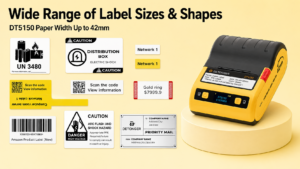
For commercial plug production, tissue-culture micropropagation labs, and greenhouse bench auditing, the Detonger DT5150 1.5-inch All-in-One Thermal Transfer Printer provides portable precision.
- Why it excels for commercial growers:Outputting at 300 DPI, the DT5150 handles narrow adhesive synthetic markers and micro-stakes for plug trays and 2-inch starter pots. It features an all-in-one consumable cassette that houses both the resin ribbon and synthetic media within a sealed cartridge, allowing staff to swap tags in seconds without touching delicate ribbons or exposing the internal mechanics to potting soil. Equipped with Bluetooth, scouts can generate replacement cultivar tags directly along greenhouse aisles.
Scaling Horticultural Operations with WePrint Software
Industrial hardware requires intuitive software to eliminate manual data entry errors. Detonger printers integrate natively with the WePrint application across iOS, Android, and Windows PC.
WePrint streamlines commercial nursery operations through dedicated workflow features:
- Excel & Inventory Database Synchronization:Wholesale growers manage expansive catalogs with complex botanical classifications. Floor supervisors can import crop spreadsheets directly into WePrint via mobile device or PC. The software automatically binds database fields to custom tag templates, populating botanical names, pot sizes, lot numbers, and pricing automatically.
- Sequential Batch & Lot Numbering:For seedling propagation and field block tracking, WePrint generates sequential identifiers and serialized barcodes, maintaining rigorous batch traceability across nursery holding blocks.
- Dynamic QR Code Generation:The software encodes URLs directly into high-contrast QR codes, directing wholesale buyers, retail garden centers, or landscape contractors to plant passports, patent registrations, or watering guidelines.
Deploying a commercial-grade plant label printer eliminates variety mix-ups, safeguards plant patent compliance, and preserves inventory visibility through every irrigation and weather cycle. Explore Detonger’s durable Thermal Transfer Label Printer collection and discover high-efficiency Industrial Label Printer for Manufacturing, Warehouse and Durable Labels systems to upgrade your commercial nursery operations today.
Frequently Asked Questions (FAQs)
Q: Can a commercial plant label printer print on thick, non-adhesive plastic stakes?
A: Yes. Purpose-built horticultural thermal transfer printers (such as the Detonger DT6250) are engineered with adjustable media guides, high-torque feed rollers, and optical black-mark sensors capable of handling non-adhesive, heavy-gauge plastic pot stakes (like PVC or styrene) as well as perforated loop-lock tree wraps. Standard consumer label makers cannot feed or print on these thick, rigid materials.
Q: Why do plant labels printed with direct thermal technology fail in commercial greenhouses?
A: Direct thermal paper uses a heat-activated chemical coating to produce text without ink. In commercial greenhouses and outdoor nurseries, exposure to direct sunlight and high ambient temperatures activates the chemical layer across the entire surface, causing the tag to turn completely black and destroying all botanical data and barcodes. Thermal transfer printing uses heated printheads to melt inert resin ribbon onto plastic tags, ensuring complete immunity to solar heat and UV radiation.
Q: How do commercial growers print plant passports and QR codes on narrow nursery tags?
A: Regulatory plant passports and wholesale tracking tags require dense information within compact spaces. Commercial growers use 300 DPI thermal transfer printers paired with software like WePrint. The 300 DPI resolution prints microscopic 2D DataMatrix or QR codes and fine 4pt typography with crisp edges, ensuring optical scanners and smartphone cameras can read the codes even after outdoor weathering.