
A waterproof label printer engineered for barcode tracking is a specialized thermal device designed for warehouse operations, chemical plants, asset management teams, and cold-chain distributors to generate scannable, moisture-resistant identification codes. Unlike generic office equipment, an industrial-grade waterproof barcode printer prevents the common scanning bottlenecks caused by outdoor rain, high humidity, wash-down protocols, and mechanical abrasion. When selecting hardware for barcode tracking in wet or humid conditions, decision-makers must evaluate three primary parameters: print technology (thermal transfer is mandatory for true chemical and water submersion resistance, whereas top-coated direct thermal suits short-term parcel tracking), optical resolution (300 DPI for micro-matrices like 2D DataMatrix and dense QR codes), and media sensor precision to eliminate barcode registration drift across high-speed production runs.
Why Standard Barcode Printing Fails in Moisture-Rich Environments
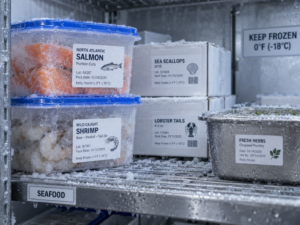
In automated distribution and inventory tracking, a barcode is useless if an optical imager or laser scanner cannot read it on the first pass. Relying on basic desktop laser printers or standard paper rolls introduces significant supply chain liabilities. Standard paper labels absorb ambient humidity, causing the paper fibers to swell. As moisture penetrates, the printed dark bars soften and bleed into the white spaces, destroying the narrow-to-wide dimensional ratio (quiet zone and bar width) required by ISO/IEC barcode verification standards.
Furthermore, direct thermal paper that lacks a protective top-coat will discolor when exposed to water, friction, or UV exposure. When a moisture-damaged barcode fails to scan on a conveyor sortation system or a delivery driver’s handheld PDA, the package or asset must be manually diverted for re-keying or relabeling.
Deploying an industrial waterproof label printer eliminates barcode degradation. By utilizing high-temperature printheads to fuse molten resin ribbons into synthetic polymers—or by precisely activating “three-proof” coated thermal paper—these devices output sharp, high-contrast barcodes that maintain 100% first-pass read rates in sub-zero freezers, outdoor staging yards, and chemical wash bays.
Key Hardware Specifications for Waterproof Barcode Production
Ensuring your barcode tags survive heavy moisture, grease, and cleaning chemicals requires hardware matching specific mechanical requirements:
- Thermal Transfer vs. Direct Thermal Architecture:For long-term tracking—such as capital asset tagging, outdoor utility meters, and chemical drum identification—you must utilize a thermal transfer label printer. The printer melts a solid resin ribbon into synthetic films like Matte Silver PET, flexible PVC, or polypropylene (PP). For short-cycle transit like e-commerce shipping, direct thermal printers running 3-proof (water-, oil-, and scratch-proof) paper offer an inkless, cost-efficient alternative.
- 300 DPI High-Resolution Output:While 203 DPI suffices for standard 4×6 courier waybills, industrial barcode labels often condense extensive tracking data into compact 1D Code 128 or dense 2D DataMatrix formats. A 300 DPI (Dots Per Inch) printhead delivers razor-sharp edge definition to the individual bars and matrix cells, ensuring scannability even on compact 15mm or 20mm asset labels.
- Industrial Substrate Handling:Waterproof barcodes rely on synthetic, tear-resistant materials that have different surface tension and thickness compared to standard paper. The printer must feature heavy-duty platen rollers and adjustable head-pressure mechanisms to maintain uniform heat transfer across thick synthetic stocks without wrinkling ribbons.
- Accurate Media Gap and Mark Sensors:Barcode automation relies on zero-drift positioning. The printer must incorporate high-precision transmissive (gap) and reflective (black mark) optical sensors to calibrate each label’s boundary precisely, ensuring barcodes never print across perforations or die-cut margins.
Comparing Thermal Technologies for Waterproof Barcode Tags
| Performance Metric | Direct Thermal (3-Proof Top-Coated Paper) | Thermal Transfer (Resin Ribbon + Synthetic Film) |
| Imaging Mechanism | Heated printhead activates chemical coating | Heated printhead melts pure resin onto synthetic film |
| Consumable Requirement | Direct thermal label roll only (no ribbon) | Synthetic label roll (PET/PP) + pure resin ribbon |
| Submersion & Water Resistance | Moderate (water beads off; fails under long soaking) | Extreme (impervious to prolonged water immersion) |
| Chemical & Solvent Resistance | Low (alcohol and grease cause fading or darkening) | Exceptional (withstands isopropyl alcohol, oils, xylene) |
| Barcode Edge Contrast Over Time | Degrades over 6 to 12 months under heat/UV | Permanent (archival-grade contrast for 5 to 15+ years) |
| Ideal Operational Environment | Cold-chain shipping labels, refrigerated food boxes | Industrial asset tracking, PCB boards, outdoor drums |
Top Detonger Models for Waterproof Barcode Labeling
Detonger leverages 16 years of independent research, global ISO9001 certifications, and 11 invention patents to deliver robust thermal hardware optimized for durable barcode printing.
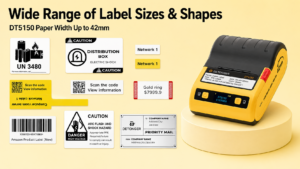
Detonger DT5150: The Compact 300 DPI Thermal Transfer Specialist
For electronics manufacturing, IT server rooms, and medical laboratories where small, waterproof 2D barcodes are mandatory, the Detonger DT5150 1.5-inch All-in-One Thermal Transfer Printer provides high-precision durability.
- Why it excels for barcodes:Outputting at a crisp 300 DPI, the DT5150 renders microscopic 2D DataMatrix and QR codes on Matte Silver PET labels down to 15mm wide without module distortion. Its all-in-one cartridge houses both the resin ribbon and synthetic media, allowing technicians to swap consumables in seconds without exposing internal components to dust or moisture.
Detonger DT6250: Multi-Format Waterproof Industrial Workhorse
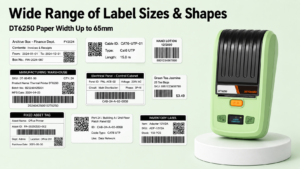
For warehouse racking, chemical containers, and manufacturing sub-assemblies requiring wider compliance labels, the Detonger DT6250 offers broad media versatility.
- Why it excels for barcodes:Supporting media widths up to 61mm (2.5 inches) at 300 DPI, the DT6250 provides ample space for dual-barcode layouts—such as a 1D routing barcode paired with an encrypted 2D tracking matrix and human-readable serial text. Its split-type architecture separates the ribbon from the label roll, lowering ongoing consumable costs for high-volume production lines.
Detonger DP40 Series: The 4-Inch Waterproof Logistics Champion
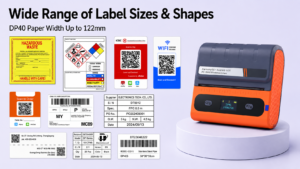
For cross-dock distribution, freight staging, and cold-chain logistics, the Detonger DP40 Series handles wide-format moisture-resistant barcodes on the go.
- Why it excels for barcodes:Accommodating media widths up to 114mm (104mm print width), the DP40 prints standard 4×6 inch logistics waybills and pallet barcodes. Paired with Detonger’s 3-proof direct thermal paper, it outputs moisture-resistant barcodes that survive rain on loading docks. Dual 2600 mAh batteries allow staff to batch-print serialized tracking labels directly from forklifts or dispatch bays.
Automating Barcode Output with WePrint Software
A dedicated waterproof label printer requires intelligent design and database software to eliminate data entry errors. Detonger hardware integrates natively with the WePrint application across iOS, Android, and Windows PC.
WePrint simplifies enterprise barcode generation through targeted features:
- Comprehensive Barcode Engine:Supports major 1D symbologies (Code 128, Code 39, EAN-13, UPC-A) and 2D formats (QR Code, DataMatrix, PDF417) with customizable error correction levels.
- Excel & CSV Database Binding:Operators can import product lists, tracking codes, or serial ranges directly from spreadsheets. WePrint dynamically maps columns to the barcode elements, allowing users to batch-print hundreds of unique, moisture-proof barcode tags in minutes.
- ERP & WMS Integration:Detonger provides multi-platform SDKs and APIs, enabling corporate IT teams to send automated barcode printing commands directly from custom warehouse management or inventory tracking systems.
Equipping your facility with a dedicated waterproof label printer protects your supply chain against scanning failures, prevents unreadable inventory records, and maintains end-to-end operational visibility in demanding environments. Explore Detonger’s specialized Barcode Label Printer for Warehouse, Inventory and Asset Tracking collection and discover high-durability Industrial Label Printer for Manufacturing, Warehouse and Durable Labels options to upgrade your barcode printing workflow today.
Frequently Asked Questions (FAQs)
Q: Can a waterproof barcode label be printed without using an expensive ribbon?
A: Yes, if your application involves short-to-medium-term logistics (like e-commerce shipping or refrigerated parcel delivery). You can use a direct thermal printer loaded with “three-proof” (waterproof, oil-proof, scratch-proof) direct thermal paper. The paper has a protective top-coat that sheds rain and moisture. However, for permanent asset tracking or exposure to harsh industrial solvents, a thermal transfer printer with a resin ribbon is required.
Q: Why do optical scanners fail to read waterproof barcodes printed at 203 DPI?
A: Optical scanners require sharp contrast and precise ratios between the dark bars and light spaces. On small barcode labels (such as those under 30mm wide), a 203 DPI printhead has larger print dots (0.125mm), which can cause the edges of adjacent bars or 2D matrix cells to bleed together. A 300 DPI printhead uses smaller dots (0.084mm), preserving the sharp geometrical boundaries required by automated laser and camera imagers.
Q: Will waterproof barcode labels stay stuck to wet or greasy metal equipment?
A: The printed barcode text will resist moisture, but label adhesion depends on surface preparation and adhesive chemistry. To secure labels on challenging equipment, wipe the application surface clean with isopropyl alcohol before applying the tag, and ensure your synthetic label stock features a high-tack, solvent-resistant acrylic adhesive.